Saturday, March 24, 2007

Creation From Nothing or By Organization
Like other Christian Churches, the Church of Jesus Christ of Latter-day Saints believes in the Bible 100%. We do not pick and choose parts that we believe and don't believe. We also say we believe the Bible “as far as it is translated correctly.” This qualifier just recognizes that there are so many versions of the Bible and that meaning and understanding can very greatly depending on how a word is translated from the original language into modern language.

There is no such thing as an un-biased translation. Obviously, if Bible translation wasn’t an issue there wouldn’t be so many translations, and there wouldn’t be so many Christian denominations and non-denominations where one church, for instances, baptizes by sprinkling, another by immersion, and another not at all. Also, any Sunday school that refers to the original Hebrew and Greek recognizes the value in trying to understand the original intent of the prophet who first recorded the scripture.

Another example of a difference in translation, which has profound effects on doctrine, religious practice, and belief, is of the word “Created”. Mainstream Christianity believes that God is the only eternal being in the universe and that everything else was created “ ex nihilo” or from nothing. The understanding or misunderstanding of the correct translation of this word has profound doctrinal implications. Much of the understanding of the mainstream Christian church is based on the Early Catholic Ecumenical Councils like Nicaea in the 4th Century and others at Ephesus, Constantinople, and Trent. When a believer in other faith quotes their belief they will often add words and phrases that are found in these Creeds and not in the Bible like “Trinity” and “coequal uncreated.” Latter-day Saints feel like our beliefs and understanding reflects that of first-century Christians and not 4th-century Christians. However, this difference in Biblical interpretation should not be considered grounds to exclude us from being considered Christian.

So, what does the LDS church believe about the word “creation?” When the Bible says, “In the beginning God created the heaven and the earth,” the Hebrew word for create is “ktidzo” which carries an architectural connotation...as in 'to build' or 'establish' a city. (Griffith, 72 FAIRWiki link.) Therefore, this word suggests that creation of the heavens and the earth was done out of pre-existing materials and not from nothing (creatio ex nihilo). Therefore, another word which could be used to translate “ktidzo” would be “In the beginning God organized the heavens and the earth” from materials that already existed.

Col. 1: 17 “For by him were all things created, that are in heaven, and that are in earth, visible and invisible, whether they be thrones, or dominions, or principalities, or powers: all things were created by him, and for him: And he is before all things, and by him all things consist.”
2 Cor. 4: 18 “While we look not at the things which are seen, but at the things which are not seen: for the things which are seen are temporal; but the things which are not seen are eternal.”

Mainstream Christianity cites Col 1:17 to support the creedal belief that God created everything in the universe from nothing. Only God is eternal and has existed forever and has no beginning or end. This mistaken understanding pre-supposes that the opposite of eternal is created. If something is eternal then it cannot be created, and if something is created than it cannot be eternal. However, if this were so, then then man could never become eternal and inherit eternal life; Because, according to the Bible, men are created beings. But the Bible also clearly promises eternal life.

2 Cor. 4: 18 clarifies the true understanding of the relationship between the words eternal and created. It says that things which are seen (physical things) are created and the things which are not seen (spiritual things) are eternal. On the surface, this seems to be a compete contradiction to Col 1:17 were it says that God created “all things… visible an invisible.” However, the point is, that just because something is created doesn’t mean it cannot be considered eternal also. The Bible teaches that all spirits were co-existent with God and are also without beginning or end.

Although our spirits or intelligence was co-existent with God, we were not at all equal with God. The process of coming to earth and recieving a body is a test necessary to becoming more like our Heavenly Father through Jesus Christ. Jesus Christ is the only way by which we can gain eternal life and therefore become not only co-existent with God, but also co-eternal with God. The Bible describes the process that Jesus Christ demonstrated when it says he "grew in wisdom and stature, and in favor with God and men." The Bible is describing the process that Jesus Christ, the Son of God, progressed through to gain eternal life and return to Heaven at the right hand of Our Heavenly Father.

Isa. 43: 10 Ye are my witnesses, saith the LORD, and my servant whom I have chosen: that ye may know and believe me, and understand that I am he: before me there was no God formed, neither shall there be after me.
Isa. 44: 6 Thus saith the LORD the King of Israel, and his redeemer the LORD of hosts; I am the first, and I am the last; and beside me there is no God.
Isa. 44: 8 Fear ye not, neither be afraid: have not I told thee from that time, and have declared it? ye are even my witnesses. Is there a God beside me? yea, there is no God; I know not any.
Isa. 45: 5-6, 14, 21-22 I am the LORD, and there is none else, there is no God beside me: I girded thee, though thou hast not known me: That they may know from the rising of the sun, and from the west, that there is none beside me. I am the LORD, and there is none else . . . Surely God is in thee; and there is none else, there is no God. . . Tell ye, and bring them near; yea, let them take counsel together: who hath declared this from ancient time? who hath told it from that time? have not I the LORD? and there is no God else beside me; a just God and a Saviour; there is none beside me. . . Look unto me, and be ye saved, all the ends of the earth: for I am God, and there is none else.
Isa. 46: 9 Remember the former things of old: for I am God, and there is none else; I am God, and there is none like me,

Mainstream Christianity sites these scriptures to support their belief that man cannot become like God and inherit Eternal Life. However, these scriptures in Isaiah are not saying man cannot become eternal. Rather, God is referring to himself as being the only God formed who can save us from our sins and make us co-eternal with God. When God says there is no God “beside me” or “before me there was no God formed, neither shall there be after me,” Isaiah means, Jesus Christ is the only way to Eternal Life. Isa. 46:9 also says there is no other “like him” however, this seems to run contradictory to 1 Jn. 3: 2.

1 Jn. 3: 2 Beloved, now are we the sons of God, and it doth not yet appear what we shall be: but we know that, when he shall appear, we shall be like him; for we shall see him as he is.”

Therefore, Isaiah is not saying that man can never become co-eternal like God, or become join-heirs of God (Rom. 8: 17). Isaiah is saying that all men can gain eternal life; but for us, there has only ever been and will ever only be one God who can save us; and that is Jesus Christ. This process of progressive diefication is signified in God's title as the Most High God; a God of gods, King or kings and Lord of lords.

The correct understanding of "creation" also fixes another problem; and that is the creation of Satan. God created all things including Satan. But if God created Satan “ex nihilo” then he is 100% responsible for everything Satan chooses to do. In other words, if God had created Satan from nothing, then God created evil thing and does evil. But, if God organized Satan from co-existent intelligence, and that intelligence carried with it an innate characteristic of “will," then God is not responsible for the exercise of that will. God allows the excercize of will according to eternal law even when it negatively affects others. Therefore, Satan and his pre-mortal followers were free to exercized their will in rejecting God's plan. We, on the other hand through the atonement of Christ, can exercize our agency by humbling ourselves and giving our will to God. In exchange, God will make us co-eternal with him through the grace of Jesus Christ.

Mainstream Christianity has hidden the most profound teaching of the Bible; who we really are. The Christian Creeds of the 4th Century and later falsely teach that God is something incomprehensible and altogether unrelated to us. According to this reasoning, mankind becomes mearly akin to fish in a fancy fish tank. Conversely, the Bible teaches the true nature of man; and that is that we are the literal spiritual offspring of God. Jesus Christ, our eldest spirit brother, showed us the way how to come to Earth and return to our Heavenly Father's right hand, heir of God and eternal life. And through Jesus Christ we really can; as the Bible commands; become holy, become perfect, and progress to become like Our Heavenly Father (John 17: 3).

Monday, March 19, 2007

Family Values vs. Global Warming

My wife and I finally viewed Al Gore's movie on global warming entitled, "An Inconvenient Truth." The presentation made some rather compelling arguments. Having a science background, I was suspicious at the claim that there was general scientific consensus on this issue and that there was now irrefutable evidence to link human carbon dioxide production to global warming. However, irrefutable claims don't sit well with me. So, I began to search for the other side of the argument.

The Evangelical Christians seemed, at first, to be the only opposition to this issue. The Christian Right claimed that the global warming issue was a distraction from the more important issue of degrading traditional family values. The LDS Church in its "The Family: A Proclamation to the Word" in 1995 supports the mainstream Evangelical Christian movement by clearly saying that the dissintigration of the family will result in personal and global catastrophy and not global warming from carbon dioxide production:

"We warn that the disintegration of the family will bring upon individuals, communities, and nations the calamities foretold by ancient and modern prophets.We call upon responsible citizens and officers of government everywhere to promote those measures designed to maintain and strengthen the family as the fundamental unit of society."

I was initially concerned that this issue would turn out to be a new religion vs. science debate like creationism vs. evolution, or the Christian Right would be seen akin to the Catholic Church vs. Galileo and Capernicus. I was hoping to find a minority of scientists who would give an organized and logical rebuttal to this highly politicized issue.

Well, I found it. The BBC produced an excellent documentary entitled, "The Great Global Warming Swindle" (Britian's Channel 4), (Google), (YouTube) that anyone interested in the issue of carbon dioxide and global warming must see. This documentary is a point-by-point rebuttal on all the issues used to support global warming by numerous well-known, expert scientists and climatologists. This documentary leaves no doubt that yes, we should take care of the enviroment; and yes, we should be more energy independent, but the link between carbon dioxide levels and global warming and the political and social movement behind it is unfounded.

The conclusion of the documentary is that there exists a cyclical warming and cooling pattern of the Earth that is caused by increased illumination from the Sun and that carbon dioxide levels lag behind temperature and are a result of temperature change rather than preceed it and cause it. CO2 isn't even a significant green house gas. Water vapor is. Remember, correlation does not equal causation.

[see also http://brainbender.blogspot.com/2007/04/great-global-warming-swindle.html]

Saturday, March 03, 2007

Are Mormon's Christians?

Members of the Church of Jesus Christ of Latter-day Saints answer with an emphatic yet humble "YES!" Christ is so central to our faith that it is in the name of our church, The Church of Jesus Christ. In fact, all prayers, meetings, services, blessings and ordinances are performed "in the name of Jesus Christ." The nickname "Mormon" comes from our belief in the "Book or Mormon: Another Testament of Jesus Christ." Members of the Church of Jesus Christ prefer to be referred to as "Christian" or "Latter-day Saints." In fact, Latter-day Saints have been discouraging the use of the nickname "Mormon" since enemies of the church coined the name soon after the restoration of the true church of Jesus Christ in 1930. However, because the church is generaly recognized my the name "Mormon," the LDS church maintains a website at http://www.mormon.org which presents information to those of other faiths who are interested in learning more about the Church of Jesus Christ.

Of course, naming your church after Christ isn't enough to be Christian. The true church of Christ must also be built upon the teachings and doctrines of Jesus Christ. All members of the Church of Jesus Christ accept Jesus Christ as their personal savior and the only way to salvation and exaltation. Members consider themselves true disciples of Christ and strive to follow his example in faith, repentance, obedience to his commandments and service and charity to our fellow man.

3 Ne. 27: 8-11 And how be it my church save it be called in my name? For if a church be called in Moses’ name then it be Moses’ church; or if it be called in the name of a man then it be the church of a man; but if it be called in my name then it is my church, if it so be that they are built upon my gospel.

Now why would so-called "mainstream" Christian churches seek to exclude the Church of Jesus Christ from being considered Christian? That has to do with our interpretation of the Bible with respect to who Jesus is. Catholic and mainstream Evalgelical Christian churches subscribe to the belief in the Trinity which was defined at 1st Ecumenical Council of Nicaea in 325 AD. The Nicene Creed as it came to be known has since been amended several times beginning with the Athanasian and Chalcedonian Creeds in 451 AD and, more recently, the Westminster Confession of Faith in 1646 AD. This latter amendment states: “There is but one only living and true God, who is infinite in being and perfection, a most pure spirit, invisible, without body, parts, or passions.” Catholic, Orthodox, and Protestant Christian churches generally accept these creeds as authoritative doctrine on the nature of God. (http://home.earthlink.net/~ronrhodes/Creeds.html).

The Church of Jesus Christ of Latter-day Saints does not subscribe to the doctrine of the Trinity as defined by the Nicaean Creed of the latter Westminster Confession of Faith. The LDS church does believe in the "Godhead" (Acts 17: 29, Rom. 1: 20, Col. 2: 9) which comprises 3 distinct and separate beings: God the Father, the Son Jesus Christ, and the Holy Ghost. These 3 individuals are all rightly referred to as God and are considered one in purpose (John 17: 11, 21-22).


Why is it important that Jesus Christ be understood as the literal Son of God? Because, the belief that Jesus Christ is the literal Son of God reveals the divine potential of man. The Bible teaches that Jesus Christ is the first-born, spirit son of God and the only physically begotten offspring of God. The Bible refers to all men and women as spiritual offspring of God. As such, Jesus Christ can be considered our spiritual elder brother. As our examplar, he showed us the path to follow in mortality. If we follow, we are promised to share with him the reward of eternal life. And as Jesus Christ ascented to heaven to stand on the right hand of God, so the righteous, faithful, repentant, and obedient in Christ will also be "joint-heirs" with Christ and inherit not only salvation from hell, but also eternal life and exaltation.

Rom. 8: 17 And if children, then heirs; heirs of God, and joint-heirs with Christ; if so be that we suffer with him, that we may be also glorified together.
Matt. 22: 42 What think ye of Christ? whose son is he?
Matt. 16: 16 And Simon Peter answered and said, Thou art the Christ, the Son of the living God.
Acts 7: 55 But [Stephen], being full of the Holy Ghost, looked up stedfastly into heaven, and saw the glory of God, and Jesus standing on the right hand of God, And said, Behold, I see the heavens opened, and the Son of man standing on the right hand of God.
.
I do not feel mainstream Christian churches are justified in saying members of the Chruch of Jesus Christ are not Christian. Subscription to the Nicean Creed or Westminster Confession is not a prerequisite of faith in Christ when the Bible, modern revelation, and the spirit of prophecy and personal inspiration clearly support the LDS understanding of what we feel is the true nature of God.

John 17: 3 And this is life eternal, that they might know thee the only true God, and Jesus Christ, whom thou hast sent.


Saturday, February 10, 2007

Oh Say What Is True

I was thinking the other day about how unique the Church of Jesus Christ of Latter-day Saints really is. Last Sunday, a friend at work was telling me about having attended Church that morning. She had attended a "contemporary" church service and commented how much more fun it was than the "traditional" services she has attended before. That got me thinking just how boring LDS meetings can be sometimes. We don't have a band, no paid clergy, no mega-sound system, sometimes the choir is off-key. But thats just fine with me. What sets the LDS church apart is the truth, testimony, and the Holy Ghost who testifies of truth.


I have noticed, when the prophets give a talk, they don't sound preachy, or tearful, or intellectual. They just talk matter-of-fact. They don't want their emotion to detract from the truth of their message. I think this serves as a great example of how we in the church should teach and bare testimony. The Holy Ghost job is to testify of truth. Therefore, all we need to do is speak truth and testimony and we will invite God's presence. So, I think the best talks try not to be overly emotional, intellectual, spiritual sounding, or preachy. There is nothing wrong with getting a bit choked up at times. But we should be careful that our manner of speech does not detract from the truth of our message. The truth is enough all by itself.

John 8: 32 And ye shall know the truth, and the truth shall make you free.
John 16: 13 Howbeit when he, the Spirit of truth, is come, he will guide you into all truth:
1 Cor. 1: 10 Now I beseech you, brethren, by the name of our Lord Jesus Christ, that ye all speak the same thing, and that there be no divisions among you; but that ye be perfectly joined together in the same mind and in the same judgment. . . . Is Christ divided?

1 Cor. 2: 1-14 And I, brethren, when I came to you, came not with excellency of speech or of wisdom, declaring unto you the testimony of God. For I determined not to know any thing among you, save Jesus Christ, and him crucified. And I was with you in weakness, and in fear, and in much trembling. And my speech and my preaching was not with enticing words of man’s wisdom, but in demonstration of the Spirit and of power: That your faith should not stand in the wisdom of men, but in the power of God. . . But the natural man receiveth not the things of the Spirit of God: for they are foolishness unto him: neither can he know them, because they are spiritually discerned.

Friday, January 26, 2007

Tell Me It Isn't True

The Ensign is the monthly publication by the Church of Jesus Christ of Latter-day Saints. February contains the amazing and wonderful conversion story of Anthony Atkins, a priest in another christian chruch for 14 years, to the true church of Jesus Christ. This article is entitled "Tell Me It Isn't True."

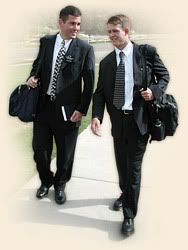
Brother Atkins writes that on April 19, 2003 he noticed 2 missionaries in the audience during the church service. In order to find out why these 2 missionaries were there and to "let them know what true Christianity was like" he spoke to them after the service. The missionaries invited him to hear their message. Bro. Atkins accepted the invitation because, as he puts it, "an hour spent with me was one less hour they could spend with some unfortunate person."

At their first meeting, Bro. Atkins was suprised to here the missionaries teach about the "the same Jesus I had loved all my life." He recieved the Book of Mormon and began reading it together with the Bible every day. He said at first, he felt guilty and said he read a page from the Bible for every page he read in the Book of Mormon. Bro. Atkins said he promised the missionaries he would pray and ask Heavenly Father to reveal to him that it wasn't true. Bro. Atkins says that that God did not reveal it, but that instead, he "found the Book of Mormon to be a deeply spiritual book that testified of the Savior," As Bro. Atkins continued to read the Bible and Book of Mormon, he saw that both supported all the teachings of the LDS missionaries.

Bro. Atkins then relates the spiritual struggle he experienced within his soul. To get his answer to prayer, Bro. Atkins planned a spiritual day at one of his favorite places in the country side. After walking from his car down a country lane he sate with his Bible on a gatepost. He opened his Bible and read verses that explained about the Apostasy (2 Thes 2) and the Restoration (2 Peter 2). There, he pondered the words of President Hinkley in a talk entitled "The Marvelous Foundation of Our Faith," which extends the invitation: "To these we say in a spirit of love, bring with you all that you have of good and truth which you have received from whatever source, and come and let us see if we may add to it." Bro. Atkins recognized that accepting these new truths would mean leaving his current job and home. He pondered the scripture and hymn "Be still my soul." It is during this moment of contemplation that Bro. Atkins noticed a cow drinking from from a small algae-covered pond and looked up and saw soaring hang gliders soaring in the sky above him. At that moment, Bro. Atkins relates, "that he comprehended through the spirit that the pond represented his present beliefs, "but they were not the springs of living water the Savior was now offering me." He sensed that the Lord was offering to take him to a higher place.

Bro. Atkins continues to relate his conversion story. He attends a baptism two days later and says how he was again overwhelmed with the spirit such that tears flowed from his eyes. He also met a friend in the LDS faith who helped him explore an alternate career. Bro. Atkins begain training at a university in social work and left his profession as a priest. And then we was baptized in the Chruch of Jesus Christ of Latter-day saints and later ordained to the Aaronic and Melchizedek priesthoods and then endowed in the temple. Bro. Atkins ends the article expressing his gratitude for the missionaries who did not give up on him.

This is how the conversion process works. There is no "brain-washing" involved here. The conversion for Bro. Atkins was a personal process of faith, reading, pondering, and prayer. He, on his own, recieved an answer to his prayer; a spiritual witness from God by the power of the Holy Ghost. And his witness was not an isolated event. Bro. Atkins felt the outpouring of the Spirit numerous times until it became a continual and constant presence.