Sunday, March 28, 2010

Baddies of the Book of Mormon

Most of us just wake up every day and go to work and come home and enjoy talking with our wives, playing with the kids, and watching a movie or game now and then. Most of us who some term "sheeple" just don't sit around planning world domination. One of the warnings and "wake up" calls in the Book of Mormon as well as the Bible is that unfortunately "bad actors" do exist. Consequently, us regular folk need to be more vigilant and remain repentant and sin free so that we can be warned of their plots, schemes, snares and pitfalls by the Holy Spirit so that we are always found standing in Holy Places.

The Book of Mormon is a Book of divine scripture similar to the Bible and is considered Another Testament of Jesus Christ. The Book of Mormon is a record of a fallen nation that suffered complete genocide by its neighbors because it rejected and broke its covenants with Jehovah. God prepared this book of scripture for our day and our benefit. Moroni a Nephite prophet writes:

Moro 1:4 Wherefore, I write a few more things, . . . that perhaps they may be of worth unto my brethren, the Lamanites, in some future day, according to the will of the Lord.

Morm 8:35 Behold,
I speak unto you as if ye were present, and yet ye are not. But behold, Jesus Christ hath shown you unto me, and I know your doing.

Morm 9:31
give thanks unto God that he hath made manifest unto you our imperfections, that ye may learn to be more wise than we have been
.

The fact that the Book of Mormon is a record of a fallen people is why Isaiah says that the Book of Mormon would speak as a voice from the dust like a voice of a familiar spirit. Familiar Spirits refer to the forbidden practice of attempting to speak or contact the dead. However, when Isaiah speaks of a "Marvelous Work and a Wonder" in the Last Days, the coming forth of the Book of Mormon from the Earth would be as a voice of a people who are speaking to us as if from the dead.

Isa 29:4 And thou shalt be brought down, and shalt speak out of the ground, and thy speech shall be low out of the dust, and thy voice shall be, as of one that hath a familiar spirit, out of the ground, and thy speech shall whisper out of the dust.


The End-Times warnings in the Book of Mormon to the Gentiles are summarized by Mormon Chapter 8 who says that when the Book of Mormon comes forth as a voice speaking from the dust it will be in a day when people will say that "miracles are done away." And Moroni warns that there will be many secret combinations or conspiracies in that day. Part of this End-Times conspiracy will be there will exist many false religions. Thus, the Last Days will be a day of sin when people are taught that God looks upon sin with a degree of allowance, where churches deny the priesthood authority of God, and where churches are built up for the purpose to get gain. In the Last Days the Gentiles will be very materialistic and prideful and seek the praise of the world over seeking to praise God. In the Last Days these conspiracies and secret combinations will prey upon the widow and the the fatherless and the people will pass by the the hungry, needy, naked, sick and afflicted and do nothing. In consequence of this apathy and pride, the Lord says that the Gentiles will be ripe with iniquity and the judgments of God will befall those who refuse to repent.

Now that we have identified where Mormon makes a summary of the perplexities that will befall the nations in the Last Days, we can then look to the rest of the Book of Mormon for more specifics on what to expect with regard to these secret combinations which Mormon and Moroni warn were the root cause of the destruction of their society and will be the cause of our destruction. Moroni is very clear that we have a duty to root out these secret combinations from among us.

Ether 8:22 And whatsoever nation shall uphold such secret combinations, to get power and gain, until they shall spread over the nation, behold, they shall be destroyed; for the Lord will not suffer that the blood of his saints, which shall be shed by them, shall always cry unto him from the ground for vengeance upon them and yet he avenge them not. Alma 37:31 Yea, and cursed be the land forever and ever unto those workers of darkness and secret combinations, even unto destruction, except they repent before they are fully ripe.


Hel 2:13 And behold, in the end of this book ye shall see that this Gadianton did prove the overthrow, yea, almost the entire destruction of the people of Nephi. 14 Behold I do not mean the end of the book of Helaman, but I mean the end of the book of Nephi, from which I have taken all the account which I have written.

When Mormon details the specifics on what we need to watch out for in the Last Days with regard to these secret combinations, Mormon gives specific examples and types by telling us the story of evil and conspiring men in his day. So, for the remainder of this post, I will attempt to make a list of Mormon's Book of Mormon villains and talk about some of what we may learn from them. In a way, each of these antagonists become types of the Anti-Christ.

Laman and Lemuel: These 2 started it all. These were the rebellious sons of Lehi and brothers of righteous Nephi and Sam. Nephi described them as being "past feeling" that even though they had seen an angel, heard the voice of God, and felt the power of God shake them, they still continually murmured about having to leave their possessions in Jerusalem, they conspired with the sons of Ishmael to leave Nephi to die in the wilderness, to throw Nephi off a cliff into the ocean, and then finally to murder Nephi over the rights to govern the people. While discussing whether a revelation given to Lehi was to be taken figuratively or literally, Laman and Lemuel fruitlessly tried to arrive at the proper understanding by contention and debate alone. Nephi, who learned from God that all scripture is both spiritual as well as literal, asked them if they had inquired of the Lord? They sadly claimed, "The Lord maketh no such thing known unto us."

Laban: Laban is a an ultra-rich Jew who is a cousin to Lehi. Of the many villains in the Book of Mormon, other than Laman and Lemuel who represent the issues of dealing with wayward children, Laban is the only one in which we get an intimate look at how they live. While Laman and Lemuel were deprived power, Laban has it all. You get the immediate sense of his influence, power, and wealth. He lives in a palace, has a treasury, has many slaves and servants who will do his dirty work, and he has a powerful circle of friends who he meets with nightly behind closed doors to make religious, political and economic decisions for the people. It is very telling that Laban keeps his scriptures, the Brass Plates, locked away in his treasury where it is of no benefit to him.

Sherem: Sherem was an outsider who learned the language and culture of the Nephites and sought to exploit certain aspects of that culture for money and power. Sherem contented against the prophet Jacob about how they observed the Law of Moses yet looked forward to the coming of Christ. Sherem called Christianity a heresy, and claimed that it was neither possible nor reasonable that a person could know anything about the future. Jacob explained that the whole Law of Moses was a type and a shadow of Christ and that all prophets had prophesied of the coming of Christ. Yet Sherem, challenging the authority of Jacob, asked for a sign as proof of God and Jacob's authority. Sherem was struck down for several days and upon waking, confessed to the people on his death bed that he had lied to God and the people.

King Noah: Early on in Nephite history, Nephi, Sam, Zoram and their families were forced to leave their first land of inheritance called the City of Nephi because of the rising threats by the Lamanites who were composed of Laman, Lemuel and the Sons of Ishmael. Years later, a group of Nephites desired to move back to the city of Nephi and repossess it. This created two bodies of believers who lost contact with each other. Consequently, it wasn't long until the king and priests of this minority community became corrupt and used their positions to excuse their materialism, sexual sin, and drunkenness. When God raised up the prophet Abinadi to call them to repentance, they burned him at the stake for blasphemy, but said they would spare his life if he would take back what he had said against King Noah.

Amulon: was the chief priest of the court of King Noah over the group of Nephites who repossessed the City of Nephi. After the city of Nephi was conquered by the Lamanites and King Noah was burned at the stake like Abinadi for cowardliness, Amulon escaped with the other priests and joined the Lamanites. They then were placed as leaders and teachers over the Lamanites and exerted especially harsh persecution, taxes, and labor upon those remaining in the City of Nephi, and upon Alma and a small group of converts of Abinadi who fled from the City of Nephi after being threatened by extermination just prior to the Lamanites conquering the city. Again we will see a reoccurring theme that just like Sodom and Jerusalem were destroyed after the righteous few were expelled, cities such as Nephi and others cities and nations will suffer the same fate.

Nehor
: was the name of the Nephite founder of an apostate sect in opposition to the Church of God headed by Alma the Younger. It used to be that you were either a believer or not. When it came to having religion, there was only one flavor. However, expanding on the evil of King Noah and Amulon, Nehor learned that if he let people go through the motions of religion without any expectation of repentance or righteousness, that many people would give him money. Nehor got in a debate with a Gideon who was a resident of the City of Nephi and witnessed the events between Amulon and Alma. Nehor became enraged and murdered Gideon. Nehor was charged with priestcraft and murder and forced to recant before he was executed. Nehor preached the following false doctrines:
1) Priests and teachers should be paid for their preaching and hold a privileged status (Alma 1:3).
2) There will be a universal salvation for all mankind. (Alma 1:4, Alma 11:37, Alma 14:5).
3) There is no need for repentance. (Alma 15:15)

Amlici: The divisions created by Nehor's sect deepened after his execution and lead to his followers violently persecuting the Church of God. These divisions were later used by Amlici to gain power and force a popular election to anoint himself king. After losing the election he rallied his followers called "Amlicites", allied with the Lamanites, and started a civil war. His campaign eventually fails but not before tens of thousands are killed on both sides. Nehor continues to attract adherents, some build the city Ammonihah in Nephite protected lands while others such as the Amalekites and Amulonites lived among the Lamanites and continually incited them to anger against the Nephites.

Zeezrom: Zeezrom was the most successful lawyer in Ammonihah. When Alma the Younger and Amulek preached repentance there, the people of Ammonihah claimed Alma and Amulek were guilty of speaking against their laws, lawyers, and judges. However, Alma retorted that he in actual fact, he spoke in favor of their laws unto their condemnation. Zeezrom took the opportunity to contend with Alma the Younger and persuade the people against Alma by first trying to cross them up in their words and then by bribing them. Instead, Zeezrom became convinced of his wickedness and began from that moment to defend Alma and Amulek. Alma and Amulek were then thrown in jail and subjected to watching their converts thrown into the fire. Alma and Amulek were rescued by miraculous means from the jail and met up with the remainder of their converts from Ammonihah. With all the righteous expelled from the city, the Lamanites unexpectedly came against Ammonihah and completely destroyed it. The ruins of Ammoniah was called "The Desolation of Nehors" from that time onward.

Amalekites: While Alma the Younger preached repentance among the the people of Ammonihah, the Sons of King Mosiah went among the Lamanites. After several suffered at the hands of the Amalekites, the Sons of Mosiah finally began to have success in converting many of the Lamanites to Christ. This success enraged the Amalekites who incited the greater portion of the Lamanites to go against the Christian converts and destroy them. Instead of fighting, these Lamanite converts prostrated themselves upon the ground before their brethren. Almost immediately, the majority of the Lamanites stopped shedding their blood and we are told the number that were converted that day exceeded the number that were slain. However, for some reason, the remaining Amalekites in their anger and frustration went over to the city of Ammonihah and were the onces responsible for destroying it. Zoram, a Nephite General, is successful in rescuing all of the survivors of the City of Ammonihah who were taken captive. Some believe that these captives would likely have been used in ritual human sacrifices. In any event, it is ironic that the followers of Nehor on the Lamanite side end up being responsible for the destruction of th followers of Nehor who remain with the Nephites after they expelled all of the righteous from among them.

Korihor: is a prominent critic of the Christian religion among the Nephites and is labeled an Anti-Christ because he declared that there would be no Christ. Korihor successfully preached social darwinism that, "every man fared in this life according to the management of the creature; therefore every man prospered according to his genius, and that every man conquered according to his strength; and whatsoever a man did was no crime." Despite a freedom of religion, Korihor's views and teachings alarmed the clerical government, who felt that his views were dangerous to their society. Korihor is turned over to Alma the Younger who is chief judge and governor, and contends that a belief in God is the result of a frenzied and deranged mind and that religion only serves as an instrument to exercise control over others and to get rich. When Alma and Korihor discuss the existence of God, Korihor demands that Alma show him a sign. Korihor is then miraculously rendered deaf and mute, upon which Korihor confesses, in writing, ...I always knew that there was a God. Korihor becomes a beggar and is eventually killed by another dissenting Nephite group known as the Zoramites.

Zoramites: Nephites suffer additional dessenters who remain in Nephite-controlled lands but were feared to eventually join with the Lamanites. These Nephite dissenters also followed Nehor in building up their own style of religious anti-Christian observance. The Zoramites were descendants of Zoram who was the servant of Laban and was persuaded by Nephi to escape Jerusalem with his family and come to America. These Zoramites rationalized their dessention based upon a perseption of past wrongs. As part of their false religious belief was a false notion of election. They claimed that they alone were elected to salvation while all others were elected to damnation. This group of Zoramites were divided into a rich and poor class. The poor among them who constructed their place of assembly were forbidden from participating because of their poverty. Alma and Amulek focus their message on these marginalized Zoramites and successfully converted most of them back to the true faith. These poor Zoramites are expelled from Antionum but allowed to join with the converted Lamanites who were now living among and protected by the Nephites in Jershon.

Zerahemnah: The leader of the unrepentant Zoramites joins with the Lamanites, and particularly the Amalekites and Amulonites in coming against the Nephites to battle. Despite the enemies superior numbers, Captain Moroni's armies are better protected, better equipped such that they are able to easily out maneuver and surrounds the Lamanite armies. Captain Moroni gives Zerahemnah several opportunities to depart with a covenant of peace but only at the last possible moment does he accept the olive branch before his army was completely annihilated. Zerahemnah and the Amalekites didn't value the lives of the Lamanites who were fighting their fight and didn't have a problem sending innumerable hosts of Lamanites without armor against the well-protected Nephites.

Amalickiah: It didn't take long for dissension to again to rise up in the church. Despite Helaman's, the son of Alma, labors to regulate the doctrine of the church by appointing elders and teachers, Amalickiah and his followers coveted absolute power over the people. After witnessing the wickedness of King Noah, King Mosiah renounced the monarchy and instituted the rule of judges among the Nephites. Following this change to a republic, many dessenters beginning with Amlici favored going back to the old way. Amalickiah attracted many followers who were lower level judges promising them increased position and power in the new government. Amalickiah desired to destroy the church of God as well as the foundation of their liberty. Amalickiah with his supporters initially sought to go against Captian Moroni to battle, but seeing that Moroni was able to rally a much larger army than his own, he headed his followers to join up with the Lamanites. Instead, Moroni was able to head them off and while Amalickiah escaped, the majority of the dissenters entered into a covenant of freedom and were permitted to return among the Nephites.

Again, Amalickiah convinced the King of the Lamanites to go to battle against the Nephites. Except this time, a large number of Lamanites refused to go. Instead, they sought refuge on a mountain top. Amalickiah was given rule over the remainder of the Lamanite armies and was given charge to compell the other Lamanites to battle against the Nephites. Amalickiah heads to the mountain where the Lamanites are held up, he convinces Lahonti to come down and comes up with a plan that the armies of Lahonti should surround his armies by night and that in the morning he would order their surrender is Lahonti would make Amalickiah second in command. After the surrender, Amalickiah poisons Lahonti and becomes general over the unified Lamanite army. He then marches back to the king, murders him in his throne room and blames it on his servants who run for it. Amalickiah convinces the queen that it must have been the servants who murdered the king because of their escape. He then "by his fraud" Amalickiah ends up marrying the queen and becomes king over all the Lamanites.

Amalikiah finally brought the armies of the Lamanites to battle against the Lamanites. He set up Zoramites as captains over them, he armed them with thick armor like the Nephites. But to his disappointment, Captain Moroni had fortified the Nephite cities with earthen walls, and timbers which successfully repells the Lamanite Armies.

Morianton: The people of Morianton had a land dispute with the people of the city of Lehi. When the people of the city of Lehi went to Captain Moroni for help, the people of Morianton made a break for the land Northward. Not wanting dissenters on the north and south, the Nephites head them off and compel them to return to their lands after having made a covenant of peace.

King-Men: Again there rose a faction among the wealthier Nephites who desired to have a king. The issue was put it to a vote. Fortunately the freemen outnumbered the king-men and the voice of the people choose to retain their liberty. However, at this same time Amalickiah was planning to come again against the Nephites and knowing this, the king-men refused to take up arms in defense of their liberty. Moroni decided to go against these king-men to battle and execute them unless they yielded to "The Title of Liberty."

Ammoron: Amalickiah came again against the Nephites and was successful in taking a good number of them on the East before reaching the northern Nephite city of Bountiful. Amalickiah is finally headed off by Teacum who is successful in stealthing into his camp at night and assassinating him. Upon finding their king dead, the Lamanites initially retreat only to appoint Ammoron, the brother of Amalickiah, as their king and maintain those cities that they had already taken. At the same time Ammoron sends for another army to come from the South and attack Nephite cities on the west and causing the war to be fought on two fronts. Ammoron pathetically justifies the war in a letter to Moroni claiming the Lamanites were wronged long ago and should have the rights to govern the people.

Pachus: Just at the point when the Nephites were able to repel the Lamanites on both the West and the East, Moroni runs out of supplies and men and suffers a terrible loss of the city of Nephihah which already had received numerous refugees from other cities. At this critical moment in the war, another king-men faction had arisen in the capital city which caused the Chief Judge Pahoran to flee the city. Moroni took a small number of men with him, and recruited additional numbers on his way to meet up with the armies of Pahoran and marched against Pachus and his king-men and held military tribunals requiring that the king-men take up the sword in defense of their country or be executed.

Moroni and Pahoran than took their army to regain Nephihah and were by stratagem able to drive the Lamanites from city to city until the Lamanite armies were again consolidated into one body. Teancum again stealthed into the Lamanite camp and assassinated Ammaron but not escape as before and was killed. The next morning Moroni was able to lead his armies and drive the Lamanites out of their lands. Moroni fortified all the border cities against future Lamanite invasions, and retired. Helaman resumed establishing the church and Pahoran returned to his work as Chief Judge.

Kishkumen: After Pahoran's death, there was a dispute among the Nephites regarding which of his 3 sons should be the next Chief Judge. The people were divided up between Pahoran Jr., Paanchi, and Pacumeni. So, they decided to let the people decide and vote on the matter. Pahoran Jr. won the election. However, that result didn't sit well with Paanchi and his followers who rebelled. Paanchi's rebellion was unsuccessful and he was put to death for sedition. His followers didn't give up so easily and hired Kishkumen to disguise himself and murder Pahoran on the judgement seat. Kishkumen successfully assassinated Pahoran and escaped and was never discovered because of the oaths that were made to conceal his identity. Consequently, Pacumeni became the Chief Judge. Following Amalickiah's fraud among the Lamanites, this hit by Kishkumen was the first Secret Combination among the Nephites.

Tubaloth and Coriantumr: Tubaloth was the son of Ammoron and became the next king of the Lamanites. Again, it wasn't long until he incited the Lamanites to go against the Nephites to battle. This time Coriantumr, a descendant of Zerahemla headed the Lamanite Armies. And this time instead of going against the well-fortified border cities, or trying to pick off smaller cities on the shores of the East Sea or the West Sea, Coriantumr went straight for the capital of Zerahemla, killing Pacumeni in the process, and began marching towards Bountiful (spiritual center). However, this tactic proved to be suicide and Coriantumr was soon surrounded, he was killed, and his armies were defeated by Nephihah.

Nephites: At this time the Nephites themselves become the definition of evil. Their wickedness results in the loss of nearly all the Land of Zarahemla up nearly to the borders of the Land of Bountiful. The Book of Mormon says that the laws were corrupted and the people could not be government by neither law nor justice. The Nephites also began to disbelieve in the spirit of prophecy and revelation and consequently became weak like unto the Lamanites. Because of this wickedness, Lehi and Nephi the sons of Helaman II tirelessly called the Nephites to repentance until Nephihah was able to regain half of their lands but no more. Then Lehi and Nephi turned their attentions upon the Lamanites and began preaching repentance among them. Then end result was a miraculous conversion of the Lamanites such that the Lamanites voluntarily yield up the remainder of the lands of the Nephites.

Alma 31:5 And now, as the preaching of the word had a great tendency to lead the people to do that which was just—yea, it had had more powerful effect upon the minds of the people than sword, or anything else, which had happened unto them—therefore Alma thought it was expedient that they should try the virtue of the word of God.


Gadianton: Gadianton becomes the leader of the band of Kishkumen. After the death of Pacumeni, Helaman was elected to be Chief Judge by the voice of the people. Kishkumen is hired to make another assassination attempt upon Helaman but Kishkumen is discovered by one of Helaman's spies and himself is killed before he can make an attempt on Helaman's life. When Kishkumen doesn't return, Gadianton fled with his band of robbers into the mountains.

Within 25 years, Gadianton's band had grown into a large criminal organization known as Gadianton's robbers and murderers, with both Nephites and Lamanites among its members. In 26 BC the Gadianton robbers assassinated Chief Judge Cezoram and his son. The Lamanites made every effort to eradicate the Gadianton robbers among them. The Nephites, in contrast, allowed the robbers to overrun their country, until the majority of them were members. Members swore to protect one another and identified each other by means of secret signs and secret words. By 24 BC the entire Nephite government was under the control of the Gadiantons. The Book of Mormon says that the people began to incite the judgments of God against them because the secret band purposefully exploits the poor and the meek, and the humble followers of God.

Around 20 BC, Chief Judge Seezoram was murdered by his brother Seantum, both of whom were members of the Gadianton band. The murder was announced and the culprit identified by Nephi the son of Helaman. Nephi's knowledge of the event was believed by many to be evidence of his prophetic powers. However, a civil war broke out not long after which was replaced by famine. The people finally repent, completely eradicate the Gadianton Robbers, and even bury their secret plans in the earth.

Giddianhi and Zemnariahah: in 12 BC, a group of disaffected Nephites dug up the secret plans and reestablished the band of Gadianton. This time the group did not infiltrate mainstream Nephite society, but rather established bases in the mountains and wilderness and made periodic raids on Nephite and Lamanite cities using guerrilla warfare. They continued to increase in power, and by AD 13 they had caused so much destruction that the Nephites and Lamanites united and declared war on the Gadiantons.

The Gadiantons initially had the upper hand in the war, and in AD 16, the Gadianton leader Giddianhi sent a letter to the Nephite governor Lachoneus demanding surrender. This letter is reproduced in the Book of Mormon and provides a rare look at the Gadianton robbers as seen by themselves. Giddianhi closes with these words: "I am the governor of this the secret society of Gadianton; which society and the works thereof I know to be good; and they are of ancient date and they have been handed down unto us". In AD 21, however, the Nephites defeated the Gadiantons, killing both Giddianhi and his successor Zemnarihah, and the society was destroyed for the second time.

Jacob: Finally a combination of factors combines like a perfect storm to overthrow the government. First there is great pride, inequality, and class distinctions based on riches and education. Second, there began to be great dissensions and contentions from within the church of God such that the church was broken up into many denominations and non-denominations. In response, God called many prophets to go forth and preach repentance to the people. Third, there was great corruption in the government such that the lawyers and the high priests of the church colluded with the judges to condemn the prophets to death secretly without approval by the governor according to the laws of the land. When these judges were brought to be judged for killing the prophets, the lawyers, high priests and families of these judges entered into a secret combination to deliver the judges from the requirements of justice. This group also conspired to remove the governor and establish a king over the land. The Chief Judge is murdered and instead of monarchy, there is anarchy. The entire government fell apart and the people were divided up into tribes. Jacob was declared king and promising many dissenters led his followers speedily into the land northward and established a kingdom beginning with a city called Jacobugath.

What happens next is the complete destruction and transformation of America. There is a 3-hour earthquake, likely volcanic eruptions, mudslides, fires, and tsunamis that destroy and or swallow whole cities. Following these cataclysmic disasters, this portion of America is enveloped in 3 days of darkness where only the laments and howling of the people can be heard through the inky blackness. After the redemptive and cleansing turbulence, tribulation, and wrath, the resurrected Christ appears to the more righteous survivors and restores His church and the fullness of the gospel again to the land.

Monday, March 08, 2010

Justin Martyr on the Relationship of Jesus Christ and God the Father

The problem with the Nicene Creed is one word which says that Christ and the Father are "homousious" or "one substance". This one word has led to the impossible mystery of the Trinity in trying to explain how 2 persons can be 1 being. On the other hand, LDS understand that God the Father and God the Son are just as Justin Martyr teaches in his discussion with Trypho the Jew; 2 numerically distinct persons, personages, and beings; yet 1 God unified in power, essence, will, and purpose. Therefore, The Nicene Creed should probably more correctly read that the Father and Son "are both composed of similar substance", or "are of similar substance" or "are composed of the same substance." It is precisely this understanding of the relationship of God the Son and God the Father and our rejection of the Nicene Creed why the rest of Christianity claims that LDS are not Christian, falsely claim that LDS are polytheists, that we worship another Christ, and claim that we are surely damned to hell.

Justin Martyr comments to Trypho Chapter 56. God who appeared to Moses is distinguished from God the Father
Justin: Reverting to the Scriptures, I shall endeavour to persuade you, that He who is said to have appeared to Abraham, and to Jacob, and to Moses, and who is called God, is distinct from Him who made all things—numerically, I mean, not [distinct] in will. For I affirm that He has never at any time done anything which He who made the world—above whom there is no other God—has not wished Him both to do and to engage Himself with. . . . 'Your throne, O God, is for ever and ever. A sceptre of equity is the sceptre of Your kingdom: You have loved righteousness and hated iniquity: therefore God, even Your God, has anointed You with the oil of gladness above Your fellows.' If, therefore, you assert that the Holy Spirit calls some other one God and Lord, besides the Father of all things and His Christ, answer me; for I undertake to prove to you from Scriptures themselves, that He whom the Scripture calls Lord is not one of the two angels that went to Sodom, but He who was with them, and is called God, that appeared to Abraham.

Christ is called God and Lord, but is numerically distinct from the Father

Justin Martyr comments to Trypho Chapter LXI—Wisdom is begotten of the Father, as fire from fire."
I shall give you another testimony, my friends,” said I, “from the Scriptures, that God begat before all creatures a Beginning,[who was] a certain rational power [proceeding] from Himself, who is called by the Holy Spirit, now the Glory of the Lord, now the Son, again Wisdom, again an Angel, then God, and then Lord and Logos; and on another occasion He calls Himself Captain, when He appeared in human form to Joshua the son of Nave (Nun). For He can be called by all those names, since He ministers to the Father’s will, and since He was begotten of the Father by an act of will; just as we see happening among ourselves: for when we give out some word, we beget the word; yet not by abscission, so as to lessen the word means both the thinking power or reason which produces ideas and the expression of these ideas. When we utter a thought, the utterance of it does not diminish the power of thought in us, though in one sense the thought has gone away from us. [which remains] in us, when we give it out: and just as we see also happening in the case of a fire, which is not lessened when it has kindled [another], but remains the same; and that which has been kindled by it likewise appears to exist by itself, not diminishing that from which it was kindled. The Word of Wisdom, who is Himself this God begotten of the Father of all things, and Word, and Wisdom, and Power, and the Glory of the Begetter.

Christ was begotten by the Father as one fire is able to kindle another fire which can stand beside the first yet is not divided therefrom nor diminishes from the first. Christ is not a chip off the old block.

Justin Martyr comments to Trypho Chapter LXII.—The words “Let Us make man” agree with the testimony of Proverbs."
And the same sentiment was expressed, my friends, by the word of God [written] by Moses, when it indicated to us, with regard to Him whom it has pointed out, that God speaks in the creation of man with the very same design, in the following words: ‘Let Us make man after our image and likeness. And let them have dominion over the fish of the sea, and over the fowl of the heaven, and over the cattle, and over all the earth, and over all the creeping things that creep on the earth. And God created man: after the image of God did He create him; male and female created He them. And God blessed them, and said, Increase and multiply, and fill the earth, and have power over it. And that you may not change the [force of the] words just quoted, and repeat what your teachers assert,—either that God said to Himself, ‘Let Us make,’ just as we, when about to do something, oftentimes say to ourselves, ‘Let us make;’ or that God spoke to the elements, to wit, the earth and other similar substances of which we believe man was formed, ‘Let Us make,’—I shall quote again the words narrated by Moses himself, from which we can indisputably learn that [God] conversed with some one who was numerically distinct from Himself, and also a rational Being. These are the words: ‘And God said, Behold, Adam has become as one of us, to know good and evil.’ In saying, therefore, ‘as one of us,’ [Moses] has declared that [there is a certain] number of persons associated with one another, and that they are at least two. For I would not say that the dogma of that heresy which is said to be among you is true, or that the teachers of it can prove that [God] spoke to angels, or that the human frame was the workmanship of angels. But this Offspring, which was truly brought forth from the Father, was with the Father before all the creatures, and the Father communed with Him; even as the Scripture by Solomon has made clear, that He whom Solomon calls Wisdom, was begotten as a Beginning before all His creatures and as Offspring by God,


God the Son and God the Father are One God in purpose yet numerically distinct and separate persons, personages and rational beings.

Justin Maryr comments to Trypho Chapter Chapter 128 The Word is sent not as an inanimate power, but as a person begotten of the Father's substance
And do not suppose, sirs, that I am speaking superfluously when I repeat these words frequently: but it is because I know that some wish to anticipate these remarks, and to say that the power sent from the Father of all which appeared to Moses, or to Abraham, or to Jacob, is called an Angel because He came to men (for by Him the commands of the Father have been proclaimed to men); is called Glory, because He appears in a vision sometimes that cannot be borne; is called a Man, and a human being, because He appears arrayed in such forms as the Father pleases; and they call Him the Word, because He carries tidings from the Father to men: but maintain that this power is indivisible and inseparable from the Father, just as they say that the light of the sun on earth is indivisible and inseparable from the sun in the heavens; as when it sinks, the light sinks along with it; so the Father, when He chooses, say they, causes His power to spring forth, and when He chooses, He makes it return to Himself. In this way, they teach, He made the angels. But it is proved that there are angels who always exist, and are never reduced to that form out of which they sprang. And that this power which the prophetic word calls God, as has been also amply demonstrated, and Angel, is not numbered [as different] in name only like the light of the sun but is indeed something numerically distinct, I have discussed briefly in what has gone before; when I asserted that this power was begotten from the Father, by His power and will, but not by abscission, as if the essence of the Father were divided; as all other things partitioned and divided are not the same after as before they were divided: and, for the sake of example, I took the case of fires kindled from a fire, which we see to be distinct from it, and yet that from which many can be kindled is by no means made less, but remains the same.


Christ is numerically distinct from the father who is begotten of the Father and not a part divided off from the Father. Christ does not act by His own power but only by the unified Power and Will with God the Father. God the Father and God the Son are numerically distinct but unified in power and essence and will.

3 Paradigms on the Christian Church

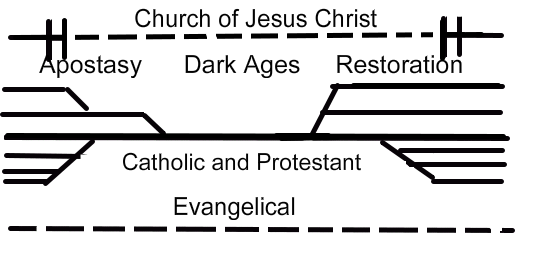
When Jesus Christ lived upon the Earth and after his resurrection and prior to His ascension to heaven, the New Testaments says that He organized a religious organization or church with Apostles, Bishops, Elders and Deacons. When it comes to modern Christian religions, there are 3 main paradigms of belief with regard to the physical and spiritual reality of Christ's Church. These 3 paradigms are described by the lines in the picture in the top left of this post.

The branched lines in the middle example represent the paradigm of the Catholic and Protestant religions. After the martyrdom of Christ's Apostles and many of the Early Church Fathers, there were many isolated and independent Christian churches scattered throughout the Roman Empire. Desiring to better unify the Empire Constantine sought to unify Christianity under one belief and doctrine. Therefore, Emperor Constantine called together many Christian theologians in what are known as the Ecumenical Councils of Nicaea, Constantinople, Ephesus, Chalcedon, Lyon and Trent, etc. The decrees of these councils were strictly enforced and dissidents were labeled heretics and punished severely.

However, this strict enforcement of orthodoxy failed to preserve a lasting unity. In 1054 the Patriarch of Constantinople rejected the Bishop of Rome's position of primacy as the supreme head over the church. Consequently, this East-West Schism resulted in the division of the church into the Roman Catholic and Eastern Orthodox Churches. Further division followed the Great Protestant Reformation from great reformers such as John Wycliffe, Martin Luther, and William Tyndale. Tyndale was declared a heretic for his English translation of the Bible and was strangled and then burned at the stake.

Many Catholics place a lot of importance in their belief that the Catholic Church has an unbroken line of priesthood authority through the Popes. On the other hand, most other Christians hold a different paradigm. Evangelical Christians do not generally view Christ's Church as a physical reality. As represented by the dotted line at the bottom of the diagram, this paradigm holds that no matter what denomination or non-denomination a person belongs, there have always been true believers which make up a figurative and spiritual body and Church of Christ. Depending on who you talk to, many Evangelicals may not believe that ordinances like baptism by immersion or partaking of the Lord's Supper are necessary.

I have found that most Christians who are are members of Protestant Churches like Baptists, Lutheran, Methodists, and Presbyterians, etc. share the Evangelical paradigm. Most denominational Christians like non-denominational Christians do not consider their membership in their respective church to have much significance. Therefore, it has become more common to see individuals and families attend a Methodist church in one town, a Presbyterian church in another town, and then a non-denominational church in another. For many Evangelicals, a church is a community of believers where they like the Pastor, find acceptance, and where they can enjoy fellowship with other believers.

The Church of Jesus Christ of Latter-day Saints presents a 3rd paradigm of belief with regard to the physical and spiritual reality of Christ's Church. The LDS Church is the restored Church of Jesus Christ and not a Protestant Church. LDS understand the Bible to foretell that together with the death of Christ, and the destruction of the temple, that the original Church of Jesus Christ would fall into apostasy. As Christ said in Matt 24, in that generation the Sun would refuse to give its light, the moon would become as blood, and the stars would fall from the sky. In other words, in consequence of the martyrdom of the Apostles and Prophets, all sources of spiritual light would cease. And just as the temple was destroyed, doctrinally speaking, not one doctrinal stone of Christ's Church would be left upon another (2 Thes 2:3) (Amos 8:11-12).

The spiritual darkness during the Dark Ages persisted until the Restoration of the Church of Jesus Christ of Latter-day Saints in the Last Days (Acts 3:19-21). After decades of spiritual darkness, God called another prophet beginning with Joseph Smith and restored the truths of the gospel, ordinances, priesthood authority, church organization, as well as His temple.

While LDS understand the Bible to teach that the Church of Christ is both a spiritual and physical reality, we do not reject the Evangelical paradigm. LDS do accept that there have been true Christian believers throughout history. If it wasn't for the spark of true belief, the Bible would still only be written in Latin, and there would not have been the Protestant Reformation. All of these realities were essential in making the Restoration of Christ's Church and gospel possible through Joseph Smith. Had Joseph Smith lived in the 1500s like William Tyndale, the Restoration would never have survived as a religious movement.

Even after the Reformation and the promise of religious freedom in America, the LDS Church hardly survived during what is known as the Mormon War. All LDS members were forced out of Missouri by mobs led by a coalition of a Methodist, Baptist, and Presbyterian clergyman and an extermination order signed by Governor Lilburn Boggs. Joseph Smith was later imprisoned and killed by an angry mob dressed in black in 1844 and the age of 38. But, the Church of Christ and the truth of God flushed none the less. This time the Church of Christ has been promised never to be taken again from the Earth. In Daniel's vision of the Last Days, Daniel sees a small small stone cut out of the mountain without hands which rolls forth until it destroys the terrible image and becomes a mountain which fills the whole Earth (Dan 2:34).

Now that the true authority and Church of Jesus Christ has been restored, we invite all true believers to join, take part in it, and rejoice together.

Degrees of Salvation

Accepting Jesus Christ as the Messiah and Savior is all is required for Salvation from Hell. But many Early Church Fathers clearly understood the Bible to teach that the degree of Salvation depended upon ones degree of acceptance of Christ (i.e. faith and obedience). Accepting Christ empowers obedience and therefore obedience is a sign of one's faith. So, while all believers in Christ will be saved in heaven, obedience to God's laws will determine the degree of our reward/gift/mansion/glory/world/seat/crown/abode/kingdom. Differing degrees of salvation does not necessarily mean a physical separation but a separation in responsibilities and opportunities to participate with God in His work of creation and eternal parenting.

Heb 1:4, 13-14 Being made so much better than the angels, as he hath by inheritance obtained a more excellent name than they. . . But to which of the angels said he at any time, Sit on my right hand. . .Are they not all ministering spirits, sent forth to minister for them who shall be heirs of salvation?

When Paul is saying that we are saved by our faith alone and not works, Paul is speaking our our initial rescue from sin and justification. Our initial rescuing from sin has nothing to do with any personal righteousness since all mankind are lost and fallen and cannot take even one step towards Christ on our own without God drawing us to Christ. "No man cometh unto me save the Father . . . draweth him" (John 6:44). This just explains that it is God that makes the first move. However, after that, the Bible is very clear that after the initial condescension of God, and our Justification, the process of Sanctification is dependent upon the degree at which we are willing to surrender our will to God and our degree of acceptance and faith in Jesus Christ which is manifest by our works and obedience. Therefore, the Bible is clear that in the end "every man" will be judged by our works.

Rev 20:12-13 And I saw the dead, small and great, stand before God; and the books were opened: and another book was opened, which is the book of life: and the dead were judged out of those things which were written in the books, according to their works. And the sea gave up the dead which were in it; and death and hell delivered up the dead which were in them: and they were judged every man according to their works.

The Biblical, Apostolic Fathers, and LDS concept of differing rewards, states of salvation, or glories is not necessarily mean a physical separation of those who are saved. Remember that Joseph Smith taught that those of a higher glory can minister to a lower glory (do the work of a lower glory), but those of a lower glory cannot minister of that of a higher (do the work of a higher glory), worlds without end. It does mean a separation in terms of gifts and responsibilities given by God to different people based on the degree of their faith in Jesus Christ.

Heb 1 says those that are glorified together with Christ, like Christ will be made higher than the angels and given a more excellent name than they. Those who desire to receive the highest gift of salvation which is exaltation will be blessed to participate with God in His work of creation and eternal parenting.

Michael Savage said on the radio tonight that Jews believe the angels are separated based on differing intelligence which intelligence is based upon their understanding of the true nature of God. This would fit Joseph Smith's explanation that those that see God as a great spirit will inherit the Telestial Kingdom and enjoy communion with God the Holy Spirit. Those whose understanding that Jesus Christ and the Father are the same Being, will enjoy communion with God the Son in the Terrestial Kingdom. And those whose understanding is that God the Father and God the Son are one God in purpose, will, and power, yet numerically distinct individuals will enjoy communion with the Father and the Son in the Celestial Kingdom. However, again, it is not clear that there is necessarily a physical separation but a figurative separation based on gifts and opportunities.

And as the presbyters say, Then those who are deemed worthy of an abode in heaven shall go there, others shall enjoy the delights of paradise, and others shall possess the splendour of the city; for everywhere the Saviour shall be seen according as they who see Him shall be worthy. [They say, moreover], that there is this distinction between the habitation of those who produce an hundred-fold, and that of those who produce sixty-fold, and that of those who produce thirty-fold: for the first will be taken up into the heavens, the second will dwell in paradise, the last will inhabit the city; and that was on this account the Lord declared, "In My Father's house are many mansions." For all things belong to God, who supplies all with a suitable dwelling-place; even as His Word says, that a share is allotted to all by the Father, according as each person is or shall be worthy. And this is the couch on which the guests shall recline, having been invited to the wedding. The presbyters, the disciples of the Apostles, affirm that this is the gradation and arrangement of those who are saved, and that they advance through steps of this nature; also that they ascend through the Spirit to the Son, and through the Son to the Father, and that in due time the Son will yield up His work to the Father, even as it is said by the Apostle, "For He must reign till He hath put all enemies under His feet. The last enemy that shall be destroyed is death."
Irenaeus, Against Heresies 5:36:1-2, in ANF 1:567,


"Conformably, therefore, there are various abodes, according to the worth of those who have believed . . . . These chosen abodes, which are three, are indicated by the numbers in the Gospel--the thirty, the sixty, the hundred. And the perfect inheritance belongs to those who attain to "a perfect man," according to the image of the Lord . . . . To the likeness of God, then, he that is introduced into adoption and the friendship of God, to the just inheritance of the lords and gods is brought; if he be perfected, according to the Gospel, as the Lord Himself taught."
Clement of Alexandria, Stromata 6:14, in ANF 2:506.


[Clement of Alexandria] reckons three kinds of actions, the first of which is . . . right or perfect action, which is characteristic of the perfect man and Gnostic alone, and raises him to the height of glory. The second is the class of . . . medium, or intermediate actions, which are done by less perfect believers, and procure a lower grade of glory. In the third place he reckons sinful actions, which are done by those who fall away from salvation.
Clement of Alexandria, Stromata 6:14, in ANF 2:506.


Origen on the interpretation of 1 Cor 15:40-42:
There are also celestial bodies, and bodies terrestrial: but the glory of the celestial is one, and the glory of the terrestrial is another. There is one glory of the sun, and another glory of the moon, and another glory of the stars: for one star differeth from another star in glory. So also is the resurrection of the dead. (1 Cor. 15:40-42)

[i]Our understanding of the passage indeed is, that the Apostle, wishing to describe the great difference among those who rise again in glory, i.e., of the saints, borrowed a comparison from the heavenly bodies, saying, "One is the glory of the sun, another the glory of the moon, another the glory of the stars."[i]
Origen, De Principiis 2:10:2, in ANF 4:294.


And some men are connected with the Father, being part of Him, and next to these, those whom our argument now brings into clearer light, those who have come to the Saviour and take their stand entirely in Him. And third are those of whom we spoke before, who reckon the sun and the moon and the stars to be gods, and take their stand by them. And in the fourth and last place those who submit to soulless and dead idols.
Origen, Commentary on John 2:3, in ANF 10:324-325.


And having said this, he ascends again to the heaven, saying, "There is one glory of the sun, and another glory of the moon." For as in the earthly bodies there is a difference, so also in the heavenly; and that difference no ordinary one, but reaching even to the uttermost: there being not only a difference between sun and moon, and stars, but also between stars and stars. For what though they be all in the heaven? yet some have a larger, others a less share of glory. What do we learn from hence? That although they be all in God's kingdom, all shall not enjoy the same reward; and though all sinners be in hell, all shall not endure the same punishment.
John Chrysostom, Homilies on 1 Corinthians 41:4, in NPNF Series 1, 12:251.


Tuesday, February 23, 2010

Restitution of All Things

Q1. "Proof of scripture in New Testament where Mormon church was established?"
Q2. "Proof of the establishment of the doctrine?"

Q3. "Proof of the Prophet Joesph Smith in the bible?"
Q4. "Proof of where Mormons gave biblical authority to have bishops, a prophet, and apostles?"


Great questions. I will support my answers with the Bible but please understand that other churches and Pastors will likely disagree with my interpretation of both the meaning and context of these verses. I have friends of many different Christian denominations and non-denominations. Every one of us desire to accept the whole Bible and not to be picker-and-chooser. However, while we all love the Bible, we can disagree about Bible interpretation as well as Bible context. My friends of other faiths interpret the Bible relying on a background of their faith tradition and what clergy have said about the Bible. After many centuries, there is a lot to choose from. LDS benefit because we interpret the Bible through the lens of the restoration and modern Prophets and Apostles. Where many opinions on the Bible exist, the Prophet can go to God for clarification on context and meaning. And that is why in addition to studying the Bible, the Bible tells us to rely upon the Holy Spirit, which was the gift of comfort given by Jesus Christ which He promised would "guide us into all truth", and "testify of [Him]", Therefore, If we really want to know the truth, the Bible tells us to knock, seek, and to "ask of God" in prayer (James 1:5). Only God can prove it to you.

All 4 questions are really derivations of the same question. The Church of Jesus Christ of Latter-day Saints is a restored church and not a branch off the Catholic church or a Protestant Church. Therefore, one way to address all these questions would be to show where the Bible demonstrates that the original Church of Jesus Christ fell into an Apostasy and therefore needed restoring. LDS interpret the following scriptures from the Bible to foretell that along with the crucifixion of Christ, and the destruction of the Jewish Temple, there would also be a rejection of true Christian authority.

1. Restitution of All Things. Throughout the Old and New Testaments, the Bible foretells through allegory and prophetic pronouncement of a future falling away and restoration in the Last Days. After reviewing many of these prophecies of the apostasy and restoration from the time of Adam, Noah, Abraham, Moses, down to Jesus Christ; Peter sums it all up when he commands all men to repent and be converted to Christ who would not return until after the apostasy and restoration or " times of restitution of all things, which God hath spoken by the mouth of all his holy prophets since the world began." Peter says clearly Christs Second Coming will not occur until there is a "time of restitution of all things". Similarly, Paul says Christs Second Coming will not occur until there is a "falling away first". Why would Peter and Paul speak of a falling way and a restitution if the covenant and authority given by Christ would continue uninterrupted? It seems clear enough here that there would be no need of a future refreshing and restitution of all things, if there wasn't first an apostasy or falling away of all things.

Acts 3: 19 Repent ye therefore, and be converted, that your sins may be blotted out, when times the of refreshing shall come from the presence of the Lord; 20 And he shall send Jesus Christ, which before was preached unto you: 21 Whom the heaven must receive until the times of restitution of all things, which God hath spoken by the mouth of all his holy prophets since the world began. . . 24 Yea, and all the prophets from Samuel and those that follow after, as many as have spoken, have likewise foretold of these days.

Just as Peter said, the Old and New Testaments contain many prophecies and allegories to a great future falling away or spiritual famine as well as an spiritual restoration before the Second Coming of Jesus Christ. The following paragraphs will attempt to highlight where the prophets in the Bible have foretold the Apostasy and Restoration just as Peter said. Take special note of key words like "prevail", "overcome", "flood", and "famine." as they are a clue that different scriptures are related.

2. Cain kills Able. One of the first stories of the Bible is the tragic story of the sorrow of Adam and Eve over Cain murdering his brother Able. But not long after, Adam and Eve rejoiced again with the birth of Seth. The death of Able and the birth of Seth serves as a type and allegory of the Great Apostasy following the Death of Christ and the Restoration before Christ's Second Coming. Like Cain and Able, Wickedness prevailed at first, but Righteousness was restored and will overcome in the end.
3. Noah and the Flood. God cleanses the Earth because of the wickedness of humanity and then re-established His covenant with Noah and his family. Again, wickedness prevailed at first, but righteousness was restored and would overcome in the end.
4. Abraham leaves Babylon. Abraham realizes that he was brought up in an apostate and idolatrous religion and leaves Babylon and is led to find the restored truth with Melchezidek, the High Priest and King of Salem.
5. Joseph is sold into Egypt. The older sons of Jacob lost out on the birthright and rights to the priesthood authority because of sin. Joseph, a younger brother received this birthright which made the other 11 brothers very jealous and resulted in their selling Joseph into Egypt. Many years later, the whole family of Jacob is forced to go to Egypt and are saved from the famine by Joseph. The House of Israel being saved by Joseph during a physical famine foreshadows the House of Israel in the Last Days being saved by another Joseph during a future spiritual famine.
6. Moses leaves Egypt. Moses is lead out of Egypt and is led to the tent of Jethro the High Priest of Midian where the truth of God was restored.
7. Moses and Aaron at Horeb. The Bible tells us an important story about Moses receiving that 10 commandments. God at that time wanted to give Israel the full gospel covenant, and God invited all the Elders of Israel up into the mountain. But the Elders refused, and told Moses "You go and speak for us". While Moses was away, the Elders became impatient and gave Aaron all their gold so that he could make them a false God to worship. Likewise, before the Second Coming, people will say Christ delayeth his return and some will give of their money to support false religion. False religion allows people to go through the motions of religion without expectations of repentance.
8. Eli and Samuel. Peter makes particular mention of this story. 1 Samuel 2-3 tells the story of Eli the High Priest of Israel. Eli's sons rejected the Lord due to being guilty of fornication. Consequently, the Lord withdrew the rights of the priesthood from the house of Eli and later bestowed the honor of High Priest and the blessings of the priesthood upon Samuel. However, for a time, the Bible says that the heavens were closed until the calling of Samuel who was just a young boy. Just like the days of Eli and Samuel, before the Last Days, there was a Great Apostasy were there was no "open visions" until God called another boy prophet by the name of Joseph Smith.

1 Sam 3:1 "And the word of the Lord was precious in those days; there was no open vision."

9. Elijah and the Famine. Elijah confronts king Ahab and Jezebel who promote the worship of Baal and Ashtoreth in Israel. Jezebel orders the killing of all Jewish Priests but Obadiah hides away 100 priests. Elijah calls down the a famine as punishment which lasts 3 1/2 years (Apostasy). During that time he is fed by the Widow of Zarephath. At the end of the drought Elijah calls down fire from heaven to consume the offering and convince the Israelites by a mightly manifestation of the power of God (Restoration).
10. Isaiah's Marvelous Work. Isaiah 29 speaks of a marvelous work and a wonder in the Last Days. Here, God says that he has covered or taken away prophets and seers from the people. All people are in a deep sleep or apostasy, but in the Last Days God will restore the truth through a book that will come out of the ground as voice out of the dust. That book is the Book of Mormon. Isaiah says that through the message of this book, those that erred in spirit will finally come to understand and learn true doctrine.

Isa 29:10 For the Lord hath poured out upon you the spirit of deep sleep, and hath closed your eyes: the prophets and your rulers, the seers hath he covered. . . 14 Therefore, behold, I will proceed to do a marvelous work among this people, even a marvelous work and a wonder: for the wisdom of their wise men shall perish, and the understanding of their prudent men shall be hid. . . 24 They also that erred in spirit shall come to understanding, and they that murmured shall learn doctrine.

11. Book of Jeremiah. The whole Book of Jeremiah is about the Apostasy of the Jews at the time preceding the Babylonian Captivity, but it also describes and foretells the future Apostasy and spiritual captivity following the death of Christ and His Apostles. The literal apostasy and captivity of the Jews and Jerusalem becomes an allegory of the future spiritual captivity, falling away and apostasy of the Christian Church. Just as Jerusalem was completely destroyed and the Jews were scattered among many nations, so we see much of the Christian world scattered among various denominations and non-denominations. But God promises He will have compassion on His people and restore them again to the truth.

Jer 3:14 Turn, O backsliding children, saith the Lord; for I am married unto you: and I will take you one of a city, and two of a family, and I will bring you to Zion: 15 And I will give you pastors according to mine heart, which shall feed you with knowledge and understanding.
Jer 9: 4 Take ye heed every one of his neighbour, and trust ye not in any brother: . . . they will deceive every one his neighbour, and will not speak the truth:. . . 16 I will scatter them also among the heathen ,
Jer 12:10 Many pastors have destroyed my vineyard. . . 15 And it shall come to pass, after that I have plucked them out I will return, and have compassion on them, and will bring them again, every man to his heritage, and every man to his land.
Jer 16:16 Behold, I will send for many fishers, saith the Lord, and they shall fish them; and after will I send for many hunters, and they shall hunt them from every mountain, and from every hill, and out of the holes of the rocks.
Jer 31:33 But this shall be the covenant that I will make with the house of Israel; After those days, saith the Lord, I will put my law in their inward parts, and write it in their hearts; and will be their God, and they shall be my people. 34 And they shall teach no more every man his neighbour, and every man his brother, saying, Know the Lord: for they shall all know me, from the least of them unto the greatest of them, saith the Lord: for I will forgive their iniquity, and I will remember their sin no more.


12. Stick of Joseph. Ezekiel is told that in the Last Days when all the 12 tribes of the House of Israel (not just Judah) are restored to their Promised Land, that the tribes will have 2 records of scripture called the "stick of Joseph" and the "stick of Judah". Ezekiel is told that prior to this Israel will be in great apostasy, but that through the unification of these records, the House of Israel which is the True Christian Church would finally be restored, sanctified, unified and purified. The "Stick of Judah" is the Bible, and the "Stick of Joseph" is the Book of Mormon.

Ezek. 37: 16, 19 Moreover, thou son of man, take thee one stick, and write upon it, For Judah, and for the children of Israel his companions: then take another stick, and write upon it, For Joseph, the stick of Ephraim, and for all the house of Israel his companions: . . .19 Say unto them, Thus saith the Lord God; Behold, I will take the stick of Joseph, which is in the hand of Ephraim, and the tribes of Israel his fellows, and will put them with him, even with the stick of Judah, and make them one stick, and they shall be one in mine hand. (see Ezek 16-28).

13. The Beast. Daniel 7 and John in Revelation foretell of a terrible beast (Roman Empire), that would arise and persecute, overcome, prevail against, and kill the saints. Daniel says that this same kingdom would change the times and the laws of the true gospel and religion (Apostasy) but in the end all dominion would be given to the people of God (Restoration). The Beast would be given a mouth that would blaspheme God, His word (Christ), His tabernacle (Christ's Body, Physicality of God, Church, and Temple), and persecute the Saints. This story is the story of what is called the Abomination of Desolation. Scripture has multiple fulfillment so this likely also applies to End-Times and the Anti-Christ.

Dan 7:21 I beheld, and the same horn made war with the saints, and prevailed against them; . . . 25 And he shall speak great words against the most High, and shall wear out the saints of the most High, and think to change times and laws: and they shall be given into his hand until a time and times and the dividing of time (= 3 1/2 year famine or Apostasy).

Rev 13:5 And there was given unto him a mouth speaking great things and blasphemies; and power was given unto him to continue forty and two months (= 3 1/2 year apostasy). 6 And he opened his mouth in blasphemy against God, to blaspheme his name, and his tabernacle, and them that dwell in heaven. 7 And it was given unto him to make war with the saints, and to overcome them: and power was given him over all kindreds, and tongues, and nations.


14. Amos Foretells a Spiritual Famine. Amos says that before the Last Days a spiritual famine would come. But unlike the day of Abraham, and Moses who were led to the truth, this time, the truth would not be found anywhere on the Earth.

Amos 8: 11 Behold, the days come, saith the Lord God, that I will send a famine in the land, not a famine of bread, nor a thirst for water, but of hearing the words of the Lord: 12 And they shall wander from sea to sea, and from the north even to the east, they shall run to and fro to seek the word of the Lord, and shall not find it.

15. Destruction of the Temple. Christ foretells that the Sun would dim, the moon would turn red, and the stars would fall from the sky meaning that all sources of heavenly light, revelation, and knowledge would cease. Christ also said of the temple (His body, His church) ;that not one stone would be left upon another (Apostasy). While the individual stones remained there wasn't a fully put together Christian church during the time of the Dark Ages that contained the cohesive whole and fullness of the truth of Christ's Church built upon a foundation of prophets and apostles; Christ being the chief cornerstone. But in the end, Christ says destroy this body and I will raise it up again the 3rd Day (Restoration). Also, remember that Christ said all this would be fulfilled at least once in that generation.

Matt 24: 2 And Jesus said unto them, See ye not all these things? verily I say unto you, There shall not be left here one stone upon another, that shall not be thrown down. 15 When ye therefore shall see the abomination of desolation, spoken of by Daniel the prophet. . . 29 Immediately after the tribulation of those days shall the sun be darkened, and the moon shall not give her light, and the stars shall fall from heaven, and the powers of the heavens shall be shaken: . . . 34 Verily I say unto you, This generation shall not pass, till all these things be fulfilled.

16. Church Built on the Rock. Matthew tells us a story about Peter's witness and testimony that Jesus is the Christ. We are taught that Peter received this witness by revelation and not scientific proof (flesh and blood). Jesus Christ promised that upon the rock of personal revelation and priesthood authority and keys, the gates of Hell would never prevail. Christ also promised to always be with His church. But, this promise doesn't mean that the people of the Church would alway stay with Christ. While Satan has no power against the church built upon revelation and Apostles and Prophets. Satan was able to prevail for a season when the people rejected revelation and the authority of the Apostles and Prophets.

Matt 16:17 And Jesus answered and said unto him, Blessed art thou, Simon Bar-jona: for flesh and blood hath not revealed it unto thee, but my Father which is in heaven. 18 And I say also unto thee, That thou art Peter, and upon this rock I will build my church; and the gates of hell shall not prevail against it. 19 And I will give unto thee the keys of the kingdom of heaven:

17. Jewish Exorcists Overcome. Later on in the Bible Luke tells the story in Acts that a son of Jewish priest attempted to invoke the name of Jesus to cast out evil spirits. But the evil spirits did not recognize the authority or faith of these Jews despite their using the name of Jesus. Consequently, Luke says that these Jews were overcome and Satan prevailed against them. If we reject the true Christian authority of Christ, then we will be left spiritually naked and wounded.

Acts 19:13 Then certain of the vagabond Jews, exorcists, took upon them to call over them which had evil spirits the name of the Lord Jesus, saying, We adjure you by Jesus whom Paul preacheth. 14 And there were seven sons of one Sceva, a Jew, and chief of the priests, which did so. 15 And the evil spirit answered and said, Jesus I know, and Paul I know; but who are ye? 16 And the man in whom the evil spirit was leaped on them, and overcame them, and prevailed against them, so that they fled out of that house naked and wounded.

18. Priesthood Authority. The New Testament teaches us about how priesthood authority is transmitted. LDS accept the doctrine of a priesthood of all believers where all members can enjoy the blessings of the priesthood instead of just the birthright son or one tribe. However, LDS also accept that the priesthood still must be transmitted by being called by God and by receiving the laying on of hands by someone who has that authority. Being called by God means a person is appointed by a divinely appointed hierarchy instead of volunteering himself or being elected. When the Apostles and Prophets were killed, that authority was lost despite God calling others as Apostles like James the Brother of Jesus, Paul, Matthias, and Barnabas. After the authority was finally lost, the priesthood was restored again when Peter James and John appeared to Joseph Smith and laid their hands on his head. In the restored Church of Jesus Christ of Latter-day Saints there is the same Apostles, Prophets, Bishops, Elders, and Deacons as in the Original Christian Church.

Eph 4: 11 And he gave some, apostles; and some, prophets; and some, evangelists; and some, pastors and teachers;
John 15: 16 Ye have not chosen me, but I have chosen you, and ordained you,
Heb 5:4 And no man taketh this honour unto himself, but he that is called of God, as was Aaron.
1 Tim. 4: 14 Neglect not the giftt hat is in thee, which was given thee by prophecy, with the laying on of the hands of the presbytery.


19. Paul foretells the Falling Away. Paul warns that Christ Second Coming would not occur until there was a great falling away first. The word for falling away in Greek is "apostasia" or Apostasy.

2 Thes. 2: 3 Let no man deceive you by any means: for that day shall not come, except there come a falling away first, and that man of sin be revealed, the son of perdition;


20. Gainsaying of Korah. Paul speaks of apostasy and authority using several Old Testament examples in His letters to Jude and Titus. So, we shouldn't think that just because a story is in the OT it no longer applies. The story of Core or Korah is very interesting when it comes to authority. Korah was a Levite but was not a son of Aaron. Korah was jealous of Aaron and believed he could lead Israel as well as or better then Aaron. Korah rebelled against Moses and Aaron and in response, God caused the earth to opened and swallow Korah and his followers. Paul warns us in several places that there would be false priests and false prophets who will practice "gainsaying," "priestcraft", and "vain talking" for "filthy lucre". Priest craft or Gainsaying involves appointing yourself or being elected as a pastor, making it a career or "craft", and preaching for money. Conversely, local LDS leadership and teachers are always called from the top down and serve in Christ's Church as an unpaid volunteer.

Jude 1: 11 Woe unto them! for they have gone in the way of Cain, and ran greedily after the error of Balaam for reward, and perished in the gainsaying of Core.
Titus 1: 9 Holding fast the faithful word as he hath been taught, that he may be able by sound doctrine both to exhort and to convince the gainsayers. 10 For there are many unruly and vain talkers and deceivers, specially they of the circumcision: 11 Whose mouths must be stopped, who subvert whole houses, teaching things which they ought not, for filthy lucre’s sake.


21. Woman fleeing into the wilderness. John tells the Early Saints a cryptic story that Satan would persecute and prevail against a woman (true church). However, John says the woman would be carried safely away into the wilderness during a period of spiritual famine until coming forth again to overcome at last. That coming forth would be accompanied by another angel who would delay the tribulation and bring the seal of God and restore the everlasting gospel of Christ. So, while the Beast is marking his people, God is sealing the elect in the forehead in preparation for the tribulation and the Second Coming of Christ. So, this restoration is not another gospel, but its the same gospel brought by another angel. This other angel is Moroni who revealed the Book of Mormon to Joseph Smith. Moroni is the angel on top of the LDS temples.

Rev 12: 6 And the woman (true church) fled into the wilderness (apostasy), where she hath a place prepared of God, that they should feed her there a thousand two hundred and threescore days (3 1/2 year famine).. . . 14 And to the woman were given two wings of a great eagle, that she might fly into the wilderness, into her place, where she is nourished for a time, and times, and half a time, from the face of the serpent. 15 And the serpent cast out of his mouth water as a flood after the woman, that he might cause her to be carried away of the flood. 16 And the earth helped the woman (Book of Mormon), and the earth opened her mouth, and swallowed up the flood which the dragon cast out of his mouth.
Rev. 14: 6 And I saw another angel fly in the midst of heaven, having the everlasting gospel to preach unto them that dwell on the earth, and to every nation, and kindred, and tongue, and people,
Rev. 7: 2 And I saw another angel ascending from the east, having the seal of the living God: and he cried with a loud voice to the four angels, to whom it was given to hurt the earth and the sea, 3 Saying, Hurt not the earth, neither the sea, nor the trees, till we have sealed the servants of our God in their foreheads.


Some say it just isn't possible that God would allow His Church to fall into Apostasy. But. just as Christ allowed evil men to kill his body and he raised it from the dead on the third day; Jesus Christ allowed evil men to at first prevail against his church and temple. Now with the restoration of all things in this the dispensation of the fullness of times, God will overcome by restoring the plain and precious truths to the Bible with the Book of Mormon, and has restored his church with 12 Apostles and a prophet, and the proper priesthood keys and authority.

Now, the question remains, was there an Apostasy and was there a Restoration. The way God has given to know this is by the Book of Mormon. We are invited to read it, ponder its message (focus on what is it saying), and then pray to God in the name of Jesus Christ if it is true. If you pray with faith, believing in Christ, you are promised a spiritual witness of the Book of Mormon by the Holy Spirit. There is no other way. Sure, It would be great to have smoking gun proof of the resurrection of Christ and of Nephites in America , but God has given that some questions can only be answered by prayer and learning to listen to the Holy Ghost. And that is done on purpose.