Monday, June 04, 2007

Zion, Politics and ER Visits
Can the true church of God be under condemnation? According to Doctrine and Covenants, the Lord refers to the church as “the only true and living church upon the face of the whole earth, with which I, the Lord, am well pleased, speaking unto the church collectively and not individually—(D&C 1: 30). So, we know that God is pleased with his church on the whole but he may be displeased with its individual members.

President Ezra Taft Benson in October 1986 general conference in a talk entitled “The Book of Mormon—Keystone of Our Religion” said, “If the early Saints were rebuked for treating the Book of Mormon lightly, are we under any less condemnation if we do the same? Can a small number of us bring the whole Church under condemnation because we trifle with sacred things?” (D&C 84:54–57). President Benson goes on quote one of his own talks from 10 years prior, “So, do eternal consequences rest upon our response to this book? Yes, either to our blessing or our condemnation.” (Ensign, May 1975, p. 65).

The Jews of the Old Testament are a good example of the chosen people living under condemnation. Can you imagine living at the time of the Jew’s exodus from Egypt? Lets say you lived in Assyria or Babylon. What would have been your view of the chosen people of God? I’m sure it wouldn’t look too desirable to join up with God’s people while they were wandering around in the desert for 40 years, especially after news of the Red Sea miracle. I can imagine them saying to themselves, “What God saves his people just to have them die in the desert?”


Sometimes, as I took at the church today, I wonder if we as a church aren’t under a bit of condemnation like the Jews. Even though we have the miracles of the First Vision and the Book of Mormon, outsiders may look at us and see a people wondering in the wilderness. Because of condemnation because of a lack of faith or obedience, can it be said of us that "and when we shall see him, there is no beauty that we should desire him" (Isa. 53: 2).

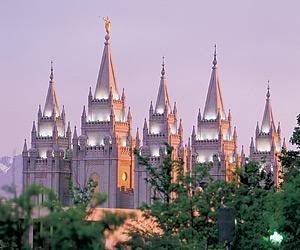
Early in church history the Saints were commanded to build a temple and establish the city of Zion and a New Jerusalem in Missouri. However, Doctrine and Covenants 101 tells us that the Saints did not obey and were driven off their land and out of the state. The Saints finally found their promised land in the West. But, we are told that the society we have built is only preparatory for the Kingdom of God that will be established before the Millennium and the second coming of Jesus Christ.

God has told Zion to "but on her beautiful garments" and "strengthen her stakes" and to be a "city on a hill" and an "ensign to the nations." The true people of God should be an example of righteousness, prosperity, and peace to all the world. When it comes down to it; where we need to start is with ourselves. We need to be an example first. So, I try to remind myself to live what I know to be true and good and hope that my example makes a difference. And I think I have in a few cases. I have a couple thank you notes to show for it. On the other hand, I think which of my failings is adding to the overall condemnation of the Church and the suffering of the world.

See, I work in an ER and I see the consequences and suffering of a great many bad decisions and also the suffering and pain caused by poverty, ignorance, hatred and bigotry first-hand. I treat drug-overdoses, shootings, assaults, rapes, sexually transmitted disease, lung disease from smoking, diabetes from overeating, heart disease from not exercising, car accidents from alcohol abuse, etc, etc. And, I hope one day to live in a better society. And I hope to make some sort of real difference to better our community; not just the "band-aid" fixes I do in the ER.

Many Christians also believe that the righteous of the Earth will one day live in a perfect society during a thousand-year period after the second coming of Jesus Christ. However, only the Mormon Church interprets the Bible to teach that God expects us to actually establish the foundation of that perfect society before Christ comes. That is a lot of responsibility for a church to take on. I think it’s a “cop-out” that some mainstream Christian churches to say that Christ will do it all for us when he comes so why bother. I think that all Christians should tirelessly seek to establish Zion here and now.

So, what would the perfect society look like? Well, the scriptures give us the blue print. They say that in a perfect society there would be no poor among us. Both the Bible and the Book of Mormon talk about communities living “with all things in common.” Everyone would be equal in heavenly and earthly things. And only then can the people of Zion, which are called “the pure in heart “ be of “one heart and one mind,” living in absolute peace and prosperity on Earth.

Everyone seems to have an idea of how to build the perfect society and get rid of poverty. We have names for these people. We call them socialists, or communists. We call them neo-cons or secular progressives. Everyone has a different theory about how to go about building a Zion or Utopia. Socialists and Secular progressives say the answer is in government programs and income re-distribution. Capitalists and neo-cons say that we should let the markets work and practice social darwinism (survival of the fittest).

The scriptures have the answer to the perfect society. We have to end poverty. But how do you do that. Do you put the government in charge of everything? If you have a problem, just turn to the government for help. That’s what we call in medicine “symptomatic treatment.” To truly be a perfect society, we have to cure the causes of poverty, ignorance, and bigotry, and hatred and not just cover them up with a welfare Band-Aid or by playing Robin Hood and imposing a mandatory income redistribution program.

To end poverty you need to attack the causes of poverty. The major cause of poverty is illegitimacy and the breakdown of the traditional family. I see the evidence of this everyday in the ER. Children have the right to be born into a family with both a mother and a father. The father should work outside the home and provide for or oversee the temporal and spiritual needs of the children. The mother should work inside the home and provide for the social and emotional needs of the children.

What happens today? We live in a sexually immoral and materialistic society. Single mothers are stretched too thin to be able to fulfill all the needs of their children by themselves. And even in cases where there is a mom and dad, many times both decide to work to fund an extravagantly materialistic lifestyle. And when the children’s spiritual, social and emotional needs are not being met, they are more likely to struggle with depression or turn to gangs, sex, porn, tobacco, alcohol, drugs which then leads to crime, disease, and injury (a visit to the ER). And the cycle repeats itself over and over again.
So, is it is impossible to expect abstinence and chastity before marriage and fidelity within marriage. And those people, who I suspect are not sexually moral themselves, want birth control, gay marriage, and abortion. But, encouraging gay marriage may result in less babies, but people who do these things feel guilt and shame, and that leads to depression which leads to addictive behavior, which leads to more visits to the ER. So, these same people say. Well, these people shouldn't feel guilty. It's because of our prejudiced society against women and gays that makes them feel guilty, depressed, and suicidal. And if we would all be more accepting, then noone would feel guilty, we can all have all the sex we want with whomever we want and not have any consequences. This is the flaw in the secular progressive left-wing conspiracy.

What about materialism? Well, the neo-conservative capitalists are no less wrong. And there is just as much of a right-wing conspiracy as there is a left-wing conspiracy. What is it? This side teaches that "I earned it so I deserve it." They want everyone to take responsiblity for themselves. However, they also practive survival of the fittest. This sides, says "He who dies with the most wealth, power, and fame wins." This leads to big businesses who pay CEO's hundreds of millions of dollars but then hire poor illegal immigrants to work for minimum wage without having to subsidize retirement or health insurance programs. Therefore, many poor uninsured do not have access to preventative health care and let little health problems go until they are big health problems and they end up in the ER.

In the end both political extremes point fingers at each other and yell conspiracy while pointing out the flaws in the other's plan. Then they mistakenly use those flaw as justification for their ideology. However, truth is, that both sides are wrong together.

I consider ER visits as measure of the of weakness and ill-health of our society. As our communities weaken; there is more illness, crime, poverty, drug use, depression, suicide, disease, accidents, injury, etc. And that means more people in the ER. I suppose a sick society is job security. But the reality is that seeing countless people suffering spiritually, emotionally, and physically is hard to see. You get numb to it or many learn to laugh at it in order to cope. I just can't laugh at the suffering of others (mostly). So, I try to focus on the Holy Ghost which can bring peace and comfort in any situation. I have a hope that one day that we will all live in that perfect society together. Maybe I'll be out of work.

Sunday, June 03, 2007

Priesthood: The Power that Connects Us

A couple of weeks ago I took Devin on a fathers-and-son’s camp out. This is a yearly ritual in the LDS church. We are blessed in Augusta, GA to live next to one the largest man-made reservoirs east of the Mississippi river in Clarks Hill/Strom Thurman Lake, which is surrounded by nearly 10 state parks and recreation areas on both its Georgia and South Carolina side. After dinner, as part of the activities, there was to be a fireside. As part of the program, several young men who ranged from Deacons, Teachers, and Priests in the Aaronic Priesthood to a newly ordained Elder in the Melchesidek Priesthood prepared some insightful thoughts on the life of Joseph Smith as it related to their experience with officiating in the priesthood.

A Deacon of the Aaronic Priesthood arose first who was about 13 years old and told the story of Joseph Smith’s vision. He told how Joseph, not being much older than he was, was curious about which of all the churches was true and which he should join and read in the Bible that he should ask God in prayer. And, on one spring morning in 1830, Joseph knelt in a private grove of trees near his home and there beheld a vision of God the Father and Jesus Christ who told him that none of the Churches were true and that Joseph was called to do a marvelous work at some future date.

Next a Teacher of the Aaronic Priesthood arose, who was about 15 years old, and old the story of Joseph Smith ‘s visitation by the angel Moroni. It had been a few years after the First Vision, and Joseph knelt in prayer at home with a desire to repent of his sins and was visited several times throughout the night the next morning by the angel Moroni who showed Joseph Smith the location of the Gold Plates from which the Book of Mormon was translated.

Then a Priest of the Aaronic Priesthood arose, who was about 18 years old, who told how Joseph, not being too much older that he was permitted by the angel Moroni finally to take the Gold Plates and interpreters from the place where they were are proceed in the work of translation of the Book of Mormon. He told of the immediate persecution which arose and how many of his neighbors tried to kill him and broke into his home to steel the Gold Plates once word got out that he had them.

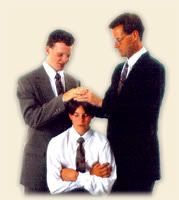
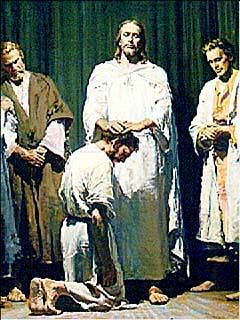
Then an Elder in the Melchesidek Priesthood arose, who was about 23 years old, who told how Joseph at his age published the Book of Mormon and who while translating the Gold Plates read about the need for baptism by water and felt he should pray to God about the necessary authority to baptize. And in response to their prayer appeared John the Baptist who laid his resurrected hands on the head of Joseph and Oliver Cowdery and conferred upon them the Aaronic Priesthood that has the authority to administer the sacrament, to baptize with water, and the blessing of the ministering of angels. And there in the Susquehanna River where they were, Joseph and Oliver baptized each other the first members of the Church of Jesus Christ in the Last Days.

And then at a later date, they were visited by a resurrected Peter and James, and a translated John who laid their hands on Joseph and Oliver’s head who bestowed upon them the keys of the Melchesidek Priesthood which has the authority to baptize with fire or, in other words, give the gift of the Holy Ghost; to give blessings to the sick; and to administer in the ordinances and covenants of the Temple. And with this priesthood authority restored to Earth after the keys were lost with the death of Christ’s Apostles and after long years of a spiritual and temporal dark age; Joseph was commanded to reorganize and restore the Church of Jesus Christ of Latter-day Saints.

Each of these boys expressed their feelings and testimony that they could relate to the story of Joseph Smith. They had asked similar questions of God in prayer such as: was the Church of Jesus Christ really God’s only true church, and if Joseph Smith really saw God and Jesus Christ and the Angel Moroni, and if the Book of Mormon was really God’s word like the Bible. And they each said that God had answered their prayers and that they knew for themselves that these things were true.

And then they expressed gratitude for their responsibilities in the Aaronic and Melchesidek Priesthoods which gave them opportunities to help others and serve God and Christ and for the connection they felt with Joseph Smith that the priesthood they had been given by their fathers had helped them connect to not only Joseph but also the Prophets in the Bible and Book of Mormon. And helped them resist tempation and to commit themselves to an honest and virtuous life as a disciple of Christ. And they expressed their gratitude that they felt the priesthood was preparing them to be men and future fathers, to get married and have a family of their own one day and be able to enjoy their family forever.

And that is what the Priesthood is all about. It is about making connections with one another that will survive death and go on into the next life. Because it’s our relationships with our spouse, family, children, neighbors, and friends that are the treasure that we can lay up in store and enjoy in heaven. And it’s the keys of the Priesthood of the Son of God who was called an High Priest after the order of Melchesidek which has the power to seal us up to God and Christ, to seal us up to eternal life, and to also seal us together as husband and wife. It is only that power and authority of God's love that can strengthen our relationships such that they will stand up not only in this life but also will extend into the next.

The Aaronic Priesthood

Last week I accompanied my father-in-law and 2 brothers-in-law to a regional young men’s meeting in Atlanta, by Charles W. Dahlquist II, who is the Young Men General President. Turns out, that all 3 have the same calling in the church. They are all young men’s presidents. That means they are in charge of organizing all the Sunday and non-Sunday activities for the LDS boys in their respective.

The meeting was wonderful. The Atlanta Stake Center (Brockett Ward) was filled to capacity with over 600 clean, neatly dressed, young men from ages 12 to 18 with their fathers. I admit the best part of the meeting was the opening hymn. The sound of 600 valiant, faithful, male voices singing one of the Hymns of Zion in praise to God and Christ got me so misty-eyed I could hardly get through the song.

After the meeting, my father-in-law was asking me what activities I had participated in which made the most difference to me in my youth. Although I remember doing a lot of fun activities with the scouts and young women, the most influential activities would have to be fulfilling the responsibilities I had in the Aaronic Priesthood.

When a boy in the LDS church turns 12 years old he is ordained a deacon and given a preparatory or Aaronic Priesthood. This is the same priesthood given to the Priests of Aaron in the Old Testament and was the authority by which John the Baptist baptized Jesus Christ. Jesus Christ later restored the higher Melchesidek priesthood to Peter, James and John. Like the Aaronic Priesthood of the OT, the Aaronic Priesthood today has the authority to perform several outward ordinances such as administering the Sacrament of the Lords Supper as well as Baptism with water. And Like the Aaronic Priesthood of the OT, today’s Aaronic priesthood prepares young men to receive the Melchesidek priesthood which has the authority to bless the sick, baptize with fire or give the gift of the Holy Ghost, and administer the blessings and ordinances of Christ’s higher law and covenant in Latter-day Temples.

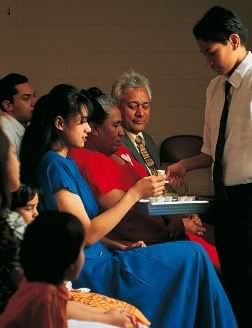
In my home ward or congregation as a boy, there were many sick and elderly who lived in several high-rise condominium complexes within the geographical boarders of the ward boundaries. Many of these sick and elderly could no longer attend church meetings and partake of the sacrament. So, the Aaronic Priesthood was assigned to bring the sacrament to many of these faithful LDS members each week. Most of the time we just came by after church and blessed and administered the emblems of the sacrament for them. Occasionally, we would visit them with the young women and hold a mini-church meeting in their small apartments. We would sing a hymn together. Sometimes someone would bring a violin or flute to provide accompaniment. Someone else would give a short spiritual thought; scripture or testimony and we would then bless and administer the sacrament.

I still only partially understand the impact that those experiences had on my life. I know I will never forget the people I was blessed to serve. I remember, Mr. Jenkins would always have us write our names down on a pad of paper when we visited. He would then proceed to remind us that he wanted our names so he could record in his journal who it was who had brought the sacrament to him that day. And then he would proudly point to a large shelf filled with binders, that contained his journal he had so faithfully kept his entire adult life. I knew that the LDS church encouraged all members to keep a journal and it was impressive to see this man who was in his mid 90’s continue to faithfully obey that instruction. His wife, much sicker, was in the next room in a hospital bed. I assume she suffered a severe stroke. She never moved or spoke. I remember one day hearing that after she finally died and that Mr. Jenkins followed her only a few hours later.

I remember taking the sacrament to Mr. and Mrs. B. Now, I knew of this Mr. B. He had been a very, very important person in his prime. But here he was, very frail and aged, weak, and rather deaf. And I think he both he and his wife suffered from Alzheimer’s but I didn’t really know much about that at the time. But, the thing I remember about brother and sister B was how they insisted on being dressed in their Sunday best in anticipation of our arrival. Also in their late 90’s, they were far too weak and frail to attend church. But they could have their home nurse get them dressed. And so I remember visiting them and administering the sacrament to them until they passed away. They faithfully participated in the church, as they were able, until the end. And I think that although this man is known to the world and admired for his great service in another important area, I will admire him and his wife most for that little detail of insisting that he be dressed in his Sunday best to take the Lord’s sacrament.

And then there was Bro. and Sister Davies. He had severe Parkinson’s disease and was confined to bed or a wheelchair. His hands shook so much with a tremor that we had to put the bread in his mouth and hold the cup to his lips. I will never forget his wife who so was so devoted to caring for her husband. Their apartment was immaculate, and he was always looked so fresh and clean. His blond straight hair never out of place. And so, again, they participated in the church and taking the sacrament which Christ asked all his disciples to do in remembrance of his sacrifice until the end of their lives.

But there was something else I realized after serving a mission. While serving as a missionary I had the opportunity to visit others who were elderly, sick, of other faiths who could no longer attend their church. And I remember hearing many of them express their sadness that they had faithfully attended their church and paid tithing their whole life and then at the end of their lives, their church had forgotten them. They felt cut off in a way from the fellowship and ordinances of the church. Yes, they could worship God at home, but they still felt like they had lost something. And, those missionary conversations helped me appreciate better the opportunity I had to serve those faithful members of my home congregation and for the Aaronic Priesthood which gave a young man of 16 and 17 the opportunity to do something so simple, yet spiritually uplifting and meaningful.


And what is so important about meaning to a 17-year-old? Well it made all the difference when I was faced with temptation. I was exposed to all the temptations and trials that all other adolescents are exposed to. But somehow, I feel through exactly these kinds of experiences, were the difference in helping me to resist temptation and make good choices while so many others did not.

Racism and Priesthood: Inspired or Uninspired

Armand L. Mauss wrote an excellent article published by FAIR, whcih presents a credible opinion to explain the historical LDS policy of race and priesthood. The paper begins with a quote by Elder McConkie in August of 1978 who says, "Forget everything I have said, or what...Brigham Young...or whomsoever has said...that is contrary to the present revelation. We spoke with a limited understanding and without the light and knowledge that now has come into the world." This quote confessed that Elder McConkie's previous arguments to biblically defend the church's policy which denied priesthood to the blacks, was wrong.

Before the 1978 revelation, Elder McConkie and others tried to support the church racial policy with the Bible. Their assumption was that Brigham Young was inspired to institute the policy. So, they interpreted the Bible to explain why such a racist policy would be heavenly justified. That lead them to racially interpret passages of scriptures which spoke of the "noble and great" in the pre-existence. McConkie and others were of the opinion that God must have denied the black race the priesthood because the blacks were spirits who were less righteous in the pre-existence. This argument is shocking to the 21st-century ear. However, Mauss cuts McConkie some slack by saying that he was faithfully, yet blindly, trying to justify an uninspired racist policy. However, after the revelation in 1978, McConkie immediately realized God's mind and will and that his previous rationalizations to defend the policy were wrong.

It is doubtful that the policy to deny the priesthood to blacks originated with Joseph Smith. Joseph Smith himself confirred the priesthood upon his friend Elijah Able. The article says that the later church policy was not inspired by God but was a product of widespread 19th-century racism and concessions by Brigham Young during his battles with the national government for statehood. The Mormon's were the most politically radical group in the nation. Mormon's opposed slavery, practiced polygamy, and were governed by a theocracy. In an attempt to gain acceptance by the political mainstream, Brigham Young relaxed or reversed some of these policies. Mauss seems to say that Brigham Young may have instituted this policy because the national goverment feared the abolishionist mormons would start preaching and converting all the slaves and encouraging them to escape to the west (not a bad idea).

Mauss argues that all christian churches were racist at that day. All the main-stream christian denominations supported slavery, denied blacks the priesthood and/or had a policy of racial segregation. These racist policies only began to change during the civil rights movement in the 1960's. However, if all the other christian chuches had begun to change their racist policies, why did the LDS church wait until 1978? No other christian churches get flack for having a racist past. Had Mormons changed with everyone else in the 1960's, we would have gotten the same pass as all the other churches. So, why did the church wait intil 1978? LDS believe that it is because it wasn't until 1978 that God finally revealed his will on the matter to Spencer W. Kimball, who was President and Prophet of the LDS church.

However, Mauss goes on to argue that the evidence supports the conclusion that the LDS church policy was not inspired but a consquence of wide-spread 19th-century racism. I'm not sure I agree with Mauss' conclusoin. I do agree that the LDS church didn't change it's race policy during the 1960's civil rights movement with everyone else because the church does not do anything that important until it receives revelation from God to do it. However, it does't make sense to me to believe the church policy is uninspired on one hand but require inspiration to revoke it on the other. Also, I don't think the Brigham Young's arguments to defend the policy are evidence for against the policy being inspired.

Brigham Young looked to the Bible to defend the policy to deny Blacks the priesthood just as he did all the doctrines and policies of the church. Many of the arguments used by McConkie and others using the doctrine of the pre-existence or the lineage of Cain, Ham etc. go back to Brigham Young. However, just because Brigham Young tried to find justification for the race policy doesn't say, one way or the other, whether the policy was inspired or not. Brigham Young would have sought to find biblical justification for the policy either way. Therefore, Elder McConkie's confession of misunderstanding in his defense of the policy cannot used as evidence that the policy itself wasn't inspired.


I disagree with Armand L. Mauss, and give as my opinion that Brigham Young would not have instituted such an important policy without first seeking and obtaining inspiration. The policy of the church was racist, but that does not necessarily mean that it couldn't also have been temporalily necessary. Just because Elder McConkie admitted after 1978 that their pevious arguments were in error, doesn't mean that the original policy wasn't given by inspiration. See my previous post for a possible argument which assumes the race policy was inspired and temporarily necessary.


That said, I am glad the priesthood is now available to all and that the church of Jesus Christ is no longer under condemnation for living briefly under a possibly preparatory and lesser-law. The Church has experienced such a great outpouring of blessings since 1978.

Saturday, June 02, 2007

Media Focus on LDS

With the presidential candidacy of Mitt Romney, the LDS church has received added attention from the media. The following is a collection of links for a few recent podcasts and articles on the LDS church.

http://www.pbs.org/mormons/
Frontline/American Experience documentary by award-winning director Helen Whitney on the LDS church which aired on PBS on April 30 and May 1, 2007. The entire 2-part documentary is available online with additional interviews, forums, and information.

http://pewforum.org/events/index.php?EventID=148
Richard Bushman, author of "Rough Stone Rolling," was guest with some of the nation's leading journalists gathered in Key West, Fla., in May 2007 for the Pew Forum's biannual Faith Angle Conference on religion, politics and public life on May 14, 2007 Key West, Florida.

http://pewforum.org/events/index.php?EventID=143
Elders Russell M. Nelson and Lance B. Wickman are guests for a Question & Answer session as part of the Pew Forum's biannual Faith Angle Conference on religion, politics and public life on May 16, 2007 Key West, Florida.

Blake Ostler, a Mormon, a lawyer, and author of a four-volume series, Exploring Mormon Thought was featured in an interview by Maureen Fiedler at Interfaith Voices which aired on NPR on May 31, 2007.
http://www.nytimes.com/2007/06/11/us/politics/11mormons.html?_r=1&hp=&pagewanted=all&oref=slogin
The New York Times talks about Mitt Romney, the media, and Mormonism. This article appeared on June 11,2007.
http://blog.beliefnet.com/blogalogue/2007/06/who-gets-to-define-christian.html
Orson Scott Card debates Dr. R. Albert Mohler, Jr. at Beliefnet.com over the question: Are Mormons Christian? The debate began on June 28, 2007 and extends to July 5, 2007.
Gerhard Spörl from the German magazine Der Spiegel interviews Elder Dieter Uchtdof. The article was posted online on July 04, 2007.
Mitt Romney details his strategy for dealing with current global issues in Foreign Affairs, published in July/August 2007.
The New York Times writes about Prof. Richard Lyman Bushman who has become a scholarly spokesman for the LDS chruch published July 28, 2007.
The New Republic invited Richard Bushman to write an article about having a mormon in the white house, published Jan 19, 2007.