Tuesday, November 06, 2007

Restored Christianity
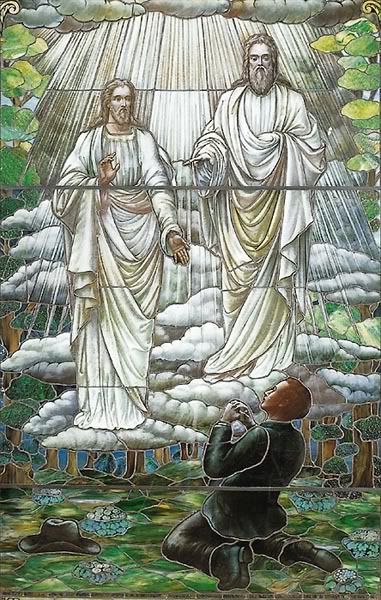
Time Magazine reported on Richard Land's, the head of the Southern Baptist Convention's Ethics & Religious Liberty Commission, labeling of the Church of Jesus Christ as a "Fourth Abrahamic Religion." While the SBC has previously considered the LDS faith a cult, Time author David Van Biema wasn't sure if this new "charitable" categorization was "a promotion or demotion."


What is wrong with letting the Church of Jesus Christ label ourselves. And who is the SBC that they can dictate who is Christian and who isn't. First off, we are not and never were trying to sell ourselves as Catholic, or Protestant, or Evangelical. Joseph Smith clearly categorized the LDS Church as RESTORED CHRISTIANITY. If you consider the official name of the church which was given by Jesus Christ to Joseph Smith via revelation; restoration is clearly inferred in the title. We are the Church of Jesus Christ of Latter-day Saints, a restored version of Christ's church in the latter days as opposed to the Church of Jesus Christ of Meridian-Day Saints.

The LDS Church holds that Christ's church which he left to his 12 Apostles was removed from the Earth. While the fruit (meaning the early Saints) would remain [in God's grace] and be exalted, the kingdom itself was lost as was the priesthood authority. Consequently the Christian world fell into the Dark Ages. Then in 1820, God initiated the restoration of His kingdom to the Earth. As part of this restoration there was a restoration of priesthood keys, prophets, Apostles, ordinances, covenants, new scripture, revelations, miracles, and temples. God's kingdom on Earth is now known as the Church of Jesus Christ of Latter-day Saints.
Now is there Biblical precedent to support such a claim of apostasy necessitating restoration? Yes! Consider Adam, Enoch, and Abraham-- the great Patriarchs. For centuries we didn't have any of their writings. The only thing we knew of them was restored via Moses. But, while the Old Testament hints, restored revelation through Joseph Smith confirms that Adam was the first Christian and that Adam, Enoch, Melchizedek, and Abraham were all Christian and practiced a very similar religion that members of the LDS church practice today except for the replacement of animal sacrifice which foreshadowed Christ's atonement for the Lord's Supper as a commemoration of his death and atonement. So, it can be said that the LDS church is also a restoration of the original Abrahamic religion as well as a restoration of the original Christian religion. We aren't the 4th Abrahamic religion. We are the original Abrahamic religion.
There is nothing in the Bible that says that God wouldn't prevent men from adding or subtracting from scripture despite his commandment to the contrary. God has not violated man's agency even in this instance. Despite the heroic efforts of inspired souls who have preserved what we have of it, the Bible has been left ambiguous. Consequently, the Bible alone has failed to bring us to a unity of the faith. Therefore, after the great spiritual famine prophesied by Amos and John who told of the church/woman fleeing into the wilderness to escape the dragon that there would need to be a great restoration of all things in this the Dispensation of the Fullness of Times. Come and see for yourself.

Saturday, October 20, 2007

Thoroughly Furnished Unto All Good Works

Jeff Robinson reports on the Southern Baptist Journal of Theology, Summer edition 2005, which is dedicated to the topic of Mormonism. In his article, published in the Baptist Press News on Sep 23, 2005, he writes that "Evangelicals often find Mormonism intriguing because of the clean lifestyle and conservative values of its adherents. Mormons may make great neighbors, but their doctrines and practices within the church appear as anything but appealing to evangelicals"

Recently, several denominational Christian Churches have come out with official doctrinal statements and resolutions stating that LDS church doctrine and practices are unorthodox, strange, or weird and not in harmony with the Bible. However, before condemning us as a heretical cult and non-Christian; these statements invariably start out praising our clean living, exemplary citizenship, and strong families. Then they warn their sheep not to be fooled by the [sheep in wolf's clothing]?

First, I cannot think of a more gracious compliment from these other faiths than to recognize the goodness and Christ-likeness of the LDS people. Chances are that you know an LDS member or family at work, school, or next door. And chances are you think they are pretty great people. But then you tell yourself that they must be the exception to the rule. I will tell you that, LDS members aren't perfect, but the reality is that your LDS neighbor or friend is only typical of most LDS members.

Now, if you give the above sheep and wolf analogy some thought you will see that it is exactly the opposite of the Bible warning (Matt. 7: 15). When the Bible teaches about false prophets in sheep's clothing, "cleansing the inner vessel" or having "clean hands and a pure heart," it is talking about the personal behavior and righteousness of the believer. The author praises LDS members for being good, honest, hardworking, family-oriented, Christ-centered on the outside but then he goes on to warn the reader to beware of their bazaar doctrines and secret temple practices on the inside? It seems the author has his analogy mixed up. When the Bible speaks of righteousness, good works, and pure religion; these aspects of true Christian worship are the fruit or outward manifestations of an inner faith and devotion to Christ and not just a facade.

Here is my point. It makes no spiritual sense to say that a person or group misunderstands correct Christian doctrine and scripture but on the other hand are exemplary in terms of their moral living, family values, citizenship, and Christ-like example. According to the Bible, the whole point of doctrine and scripture in the first place is to teach you how to behave and believe and act in away that God approves of. A person cannot be Christ-like if he does not know Christ.
James 1: 27 Pure religion and undefiled before God and the Father is this, To visit the fatherless and widows in their affliction, and to keep himself unspotted from the world.
2 Tim. 3: 17 That the man of God may be perfect, throughly furnished unto all good works.
1 Tim. 1: 5 Now the end of the commandment is charity out of a pure heart, and of a good conscience, and of faith unfeigned:
John 13: 35 By this shall all men know that ye are my disciples, if ye have love one to another.
Matt. 7: 16, 20 Ye shall know them by their fruits
1 Cor. 13: 8 Charity never faileth: but whether there be prophecies, they shall fail; whether there be tongues, they shall cease; whether there be knowledge, it shall vanish away.

Unfortunately, many evangelical Christians do not recognize the importance of correct Christian doctrine because there exists such a disunity of doctrine even within churches of the same denomination in the same city. Most of my friends and colleagues tell me that it doesn't matter much what the exact doctrines are, so long as they worship Christ and study from the Bible. LDS members do not hold such a casual attitude with regard to doctrine. The LDS Church has a unified doctrine. Anywhere you go in the world, any LDS church you attend, you will hear the exact same doctrine taught and religion practiced.

Now I hope I don't have to convince you that doctrine matters. Pick a doctrine and I will give you an example of someone who excused themselves in sin, or made an incorrect choice because they did not understand the fundamentals of Christian discipleship. That doctrine does matter is the foundation assumption of these many recent doctrinal resolutions passed by the denominational Christian religions.

The point is that one of many reasons I am a member of the Church of Jesus Christ is because I feel more "thoroughly furnished unto all good works." The LDS church helps me be a better husband, a better father, a better neighbor, and a better disciple of Christ. The LDS church helps my family be stronger, more unified and more Christ-centered. Stats support that active LDS members and families are wealthier , are more educated, have much less divorce, live longer, have a lower rate of teen pregnancy, and give more to charity than active members of any other Christian denomination. So, despite our seemingly weird and wolfish doctrine, we really are Christ's sheep inside and out.

Also, the LDS Church has a far more developed culture of caring than any other religious organization. As an LDS member, I know that my and families spiritual and temporal needs will be cared for until death and beyond. Unfortunately, many of my religious friends have lamented at how poorly their church responds to individual crisis. In the LDS church, we really do take care of each other.

Doctrinally speaking, Other Christian Churches call us a non-Christian, unorthodox, religious cult because of our rejection of what we consider to be a heretical 3rd-century AD doctrine on the trinity which was fabricated in 325AD at the 1st ecumenical council of the Catholic Church. First off, the world trinity is not found anywhere in the Bible. LDS believe in the GodHead, which is found in the Bible (Acts 17: 29, Rom. 1: 20, Col. 2: 9). The GodHead comprises God the Father, The Son Jesus Christ, and The Holy Ghost who are 3 distinct entities with glorified bodies (Acts 7: 55-56), parts (Rev. 4: 2), and righteous passions (John 3: 16); but are knowable (1 Jn. 4: 7)(John 17: 2-3), and comprehensible through the Holy Spirit (1 Cor. 2: 11), and who are one in purpose (John 17: 11, 22).

All LDS doctrines including the temple are clearly supported by the Bible and by modern revelation by prophets and apostles which is also Biblical. Also, the LDS church is not and never was trying to pass ourselves off as evangelical or protestant. Joseph Smith taught that our faith and religion should be considered Restored Christianity. Our doctrine is more in-line with 1st Century Christianity than the later corrupted 3rd -century version. But if the other Christian denominations insist on excluding us from being considered Christian, at least they recognize us for being Christ-like which is what really matters.


Tuesday, October 02, 2007

Newsweek on Mitt Romney: Personal Belief and Presidency

The sub-title of this most recent Newsweek article “Voters can't connect with a candidate they feel they don't know. Mitt Romney has to decide how much he wants to share,” is evidence of an unfortunate misunderstanding about LDS Doctrine with regard to the responsibility of a an LDS member who serves in public office. A member of the LDS Church is expected to live up to his personal and religious beliefs in any and all circumstances but a public servant is admonished never to legally force or impose those beliefs on a majority who do not share those beliefs (Mosiah 29: 26).

Mitt has been clear that he doesn’t want to talk about the LDS Church but Newsweek claims, “Romney has downplayed both his religion and his own family history.” The LDS Church is not running for the presidency—Mitt Romney is. Jesus Christ taught that believers should not “cast their pearls before swine.” LDS members do not interpret this to mean that non-LDS are "swine" but that there is an appropriate place and time to speak of sacred matters. LDS hold their beliefs sacred but not secret. If a person wants to learn about the LDS faith, they are invited to speak to LDS missionaries who are appointed by the church to teach the LDS message.

Newsweek criticizes Romney for not reminiscing with a reporter about his attendance at an old LDS church in Pontiac, MI at the age of 10. I’m not sure I could say much about my membership in the LDS church before age 10 except for my baptism day. Maybe he could have talked about his happy childhood but there is nothing special about an LDS church building itself. They’re all the same. That’s why LDS members say they can go anywhere in the world and hear the exact same gospel message and feel the exact same Spirit. For LDS members, the joy comes from Christ, His gospel, and fellowship with the saints, and not the building.

Newsweek says, “Mindful of the sway of evangelical Christians over the GOP base, he has positioned himself as the candidate with conservative principles and strong faith, even adopting evangelical language in calling Jesus Christ his "personal savior" (vernacular not generally used by members of the Mormon Church).”

Yes, Mitt wants the support of the evangelicals. But to say that members of the Mormon Church don’t generally call Christ our “personal savior” is inexcusable. Other than the phrase “my personal savior” being grammatically redundant, every testimony given of Jesus of Nazareth from Joseph Smith, through all the Apostles and Prophets down to the prayers given by LDS members at home or over the pulpit has contained the confession of belief that Jesus is the Christ, Savior, and Redeemer.

Mitt’s response to the “Baptism for the dead” question with the remark, "I have in my life, but I haven't recently" is more a reflection that these baptisms are more generally done by LDS adolescents (which the article explains later on) than Mitt trying to distance himself from his religion.

Newsweek claims that “Romney has been unable to shake his authenticity problem,” calling Mitt a “flip-flopper" for his “all-too-convenient conservative-conversion” with regard to gay rights and abortion. When Mitt ran for governor of Massachusetts, he knew the majority of the electorate was pro-choice. It should be well known to the media from the famous Reed Smoot hearings that LDS Doctrine holds that LDS leadership and members need not impose their personal or religious beliefs on the majority. We call that “unrighteous dominion,” which is expressly forbidden in our Doctrine and Covenants (D&C 121: 37, 39).

So, there is nothing, which detracts from Romney’s faith for him to say when he was running for Governor of a state where a majority of it’s residents are of a liberal political ideology that, as governor, he wouldn’t try to impose his personal belief’s on his constituency by overturning Roe v. Wade. Although at the same time, as governor, he fought hard to preserve the status quo and oppose a vocal minority who sought to propagate an ideology of death against the wishes of the majority of his constituency.

The account of the exchange student Tito Cortella who lived with the Romney’s is a profound example that is in stark contradiction to the author’s conclusions. Tito recounts that the Romney’s strongly encouraged him to attend the local Catholic Church and allowed him to smoke in his room. Other clear examples of this principle are beautifully described in the article including how the Romney’s kept alcohol in their home for guests and how Romney approved an investment in a media company which also included R-rated material. Romney approved the deal but did not invest any of his personal money.


Now that Romney is running for President, his constituency shares his personal ideology of life. Therefore he can, without reservation, run a campaign based on that ideology. This is not Romney re-inventing himself. This is a man who is running on the principle that a leader should not impose his ideology on others but he should persuade them to do well by patience, perseverance, and example.

(The LDS Church encourages its members to be politically active but does not support a particular party or candidate, even if he happens to be LDS. But don't be surprised if Romney win's Utah)


Friday, September 28, 2007

Cool Things About Being A Latter-Day Saint

Augusta is a great family town. However, it is also a rather transient town. The major employers in the city are the Savannah River Site National Nuclear Laboratory, Medical College of Georgia, and Fort Gordon Army Base. These employers recruit nationally, and consequently there are diverse families here from all over the country. So, as a new-comer to the area or a"johnny-come-lately" as they like to say, there are many families in the same boat which makes for accepting neighbors.


Fitting into our new LDS church was no problem. When you become Mormon or a Latter-Day Saint, you do not pick and choose were you are going to go to church. Congregations are geographically defined. That means, that you go to church with the people in your neighborhood where you are assigned to go. The result is that LDS congregations are proportionately some of the most diverse congregations in the country. This system also fosters both temporal and spiritual equality in the church. Their are not big mega-churches and small poor churches except for where new branches are still building membership in a particular geographical area.

The last 2 years my wife and I have enjoyed fellowship in our current congregation. We have brought dinners, thrown baby showers, and exchanged babysitting with many fellow congregatants and have had many dinners brought over to us. The church has a system of visiting and home teaching where 2 women congregants and 2 male congregants are assigned stewardship over another family in the congregation. This means, that even those who don't make friends easily have people availible to bring them dinners and serve them and help them. In this way and others there really isn't any poor among us.

In addition, the doctrine and structure of the meetings, and the feeling of God's spirit is exactly the same as the LDS congregations we left in Utah. I have lived in Utah, California, Wisconsin, and now Georgia; and the doctrine, structure, and Spirit is exactly identical in all the churches I have attended. My wife has attended congreations in Boston, Idaho, California, Texas, Utah and Georgia and she is in complete agreement. This unification of doctrine is possible because of a centralized leadership of a Prophet and 12 Apostles just like the Church of Jesus Christ of Meridian-Day Saints. Also, doesn't it make sense that the same God would reveal his doctrine the same in California and Georgia.

The inspiration for this post comes from feelings of compassion for a great Protestant Christian couple who are good friends of ours. They have been living in the area for the same time period and have not found a Protestant church they like. They have decided on a particular denomination but haven't liked the spirit they've felt in the countless congregations they have attended so far. They didn't like one congregation because it seemed too rich and prideful, and they didn't approve of another because they ordain female clergy expressly forbidden by their particular convention of which they are accepted and recognized to be a part of.

Despite our many invitations to attend the Church of Jesus Christ and to read the Book of Mormon, my friend told me that he is really happy and life is going good and that "he is not looking." And then he started telling me something about that the "enemy of best is good." Which was exactly what I was thinking. He seems to be comfortable with good enough. But so far it doesn't seem good enough. And they haven't read a word out of the Book of Mormon either, let alone ask God if its His word and get an answer that it is like another friend at work who was baptized last week (Hurrah for Israel) but I had very little to do with.

Anyways, 2 new LDS families moved into our neighborhood a couple months ago and not 30 minutes after my wife meeting the other wives we were swapping baby sitting. I mean, where in the world could you do that. Having just met someone for 30 minutes and already we are entrusting them with the care of our children. Where does this social capital come from? Well, it has to do with the strict promises and covenants these couples have made to God. My wife and I have made these same covenants. And when you talk to people who have made similar commitments to keep God's commandments, and they have been born again, and they are filled with the light of his Spirit, you know it and you can feel it. That doesnt mean they are perfect and are above temptation. But, you know how they feel about breaking their promises to God because you feel the same way. And that's how it works in the LDS Church.

It also works that we purchased our home in Augusta over the phone and almost exclusively on the recommendation of other LDS families. We had been to Augusta before but we didnt have time or money to visit again. So, we called up an LDS family we knew of in the area and we told them we would be moving into the area. They called us a couple weeks later saying that the house down the street was just put up for sale and that their neighborhood was the one we should live in. They took pictures of the house and helped with the inspection process and we made an offer on it without even seeing it in person. And, it has been the perfect house, in the perfect location for our family. Again, this is just a small manifestation or fruit of God's Kingdom on Earth.

I invite you to read the Book of Mormon for yourself. It testifies that Jesus is the Christ. It is the word of God together with the Bible. After you read it, pray to God and ask him if it is true. It really is that easy and hard at the same time. It does require some effort. Is it worth it to you to know the truth? It was to me, and by this formula I know for myself that it is true; and not once but again and again.

Sunday, September 16, 2007

Church Practices Influence Utah Health and Demographic Statistics

The following document, published 7 December 2001, was made available to the press during in preparation for the 2002 Winter Olympics held in Salt Lake City, Utah.

The following statistics are listed here for the use of journalists. They show where Utah scores high in a number of areas, including family, health, crime and education. These statistics cover the entire state of Utah, not just the population who belong to The Church of Jesus Christ of Latter-day Saints. In 2000, Utah was one of only three states to receive a straight-A score in a national report card based on a number of criteria (1).

Families in Utah
Utah ranked highest in the number of married-couple families, with an average of 63.2 percent. (2)
Utah ranked highest in the number of family households, with 76.3 percent. (2)
Utah ranked highest in the number of persons per family, with an average of 3.57. (2)
Utah ranked first for the youngest total population, with nearly one-third of its population 17 years old or younger. (2)
Utah ranked highest in the number of persons per household, with an average of 3.13. (2)
Utah ranked third for the fewest number of single-headed households with children, with 7.7 percent. (2)
Education in Utah Utah ranked fourth for the highest population of persons age 25 and over with a high school degree at minimum, totaling 91 percent. (3)
Utah ranked 11th for the highest population of persons age 25 and over with a bachelor's degree or higher, totaling 27.9 percent. (3)
Utah ranked fifth for the highest percentage of ninth-grade students who graduated within four years, increasing from 77.8 percent in 1999 to 82.3 percent in 2000. (4)

Health in Utah
Utah ranked first for the lowest prevalence of smoking, with 14 percent. (4)
Utah ranked first for the lowest risk for heart disease, and was 20 percent below the national average. (4)
Utah ranked first for the lowest number of cancer cases, with 239.5 cases per 100,000. (4)
Utah ranked first for the lowest number of work days missed within a 30-day period due to physical or mental illness, with an average of under three days per month missed. (4)
Utah ranked second for the lowest overall death rate, with only 5.6 deaths per 1,000. (3)
Utah ranked second for lowest number of heart-disease mortalities, and was the most improved state since 1990. (4)
Utah ranked third for best overall health in 2000, maintaining its high standing in this category during the past decade (second in 1994 and 1996; fourth in 1990; fifth in 1992, 1997 and 1998; and sixth in 1999). (4)
Utah ranked fourth for the lowest infant mortality, and fifth in the nation for lowest total mortality.
Utah ranked ninth in the nation for lowest premature death (death before age 75). (4)

Crime in Utah
Utah ranked 12th for the lowest crime rate. (3)
Utah's index crime rate (murder, rape, robbery, aggravated assault, burglary, larceny, motor vehicle theft and arson) decreased 12.6 percent compared to 1999, and 29.7 percent compared to 1995. It was 5.3 percent lower than the national index crime rate and represented a 21-year low. (5)

Other Utah Statistics
Utah ranked highest in charitable giving. (1)
Utah was the fourth fastest-growing state, with a 29.6-percent population increase during the past decade (from 1.7 million in 1990 to 2.2 million in 2000). Utah's growth rate more than doubled the nation's growth rate of 13.2 percent. (3*) Utah supports 1,000 churches representing 67 religious denominations. (3**) Over 75 percent of Utah's population are members of The Church of Jesus Christ of Latter-day Saints. (6)

Sources:
(1) The Corporation for Enterprise Development, "Development Report Card for the States 2000," http://www.drc.cfed.org/
(2) Utah Government (citing the 2000 Census), http://www.utah.gov/
(3) Economic Development Corporation of Utah (citing the "2001 Economic Report to the Governor"), http://www.edcutah.org/
(3*) Economic Development Corporation of Utah (citing the 2000 Census), www.edcutah.org (3**) Economic Development Corporation of Utah, http://www.edcutah.org/
(4) United Health Group, "United Health Group State Health Ranking: 2000 Edition," http://www.unitedhealthgroup.com/
(5) Utah Commission on Criminal and Juvenile Justice, "2000 Crime Statistics," http://www.justice.state.ut.us/
(6) Deseret News 2001-2002 Church Almanac

http://fhss.byu.edu/adm/hickman_lecture.htm