Wednesday, March 19, 2008

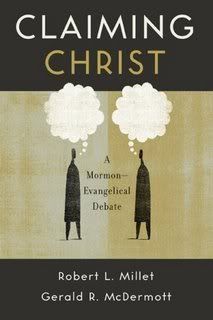
Claiming Christ: A Mormon-Evangelical Debate

Robert L. Millet (Professor of Ancient Scripture BYU) and Gerald R. McDermott (Professor of Religion Roanoke College) co-authored a new book entitled Claiming Christ: A Mormon-Evangelical Debate. With the recent presidential candidacy of LDS Mitt Romney and former Baptist minister Mike Huckabee, there has been an increase in press coverage about the LDS church and a little antagonism between Mormons and Evangelicals. This Book by Dr. Millet and McDermott seeks to find common ground between the two faith traditions as well as respectfully discussing distinctions.

Dr. McDermott concedes that Mainstream Christianity has been falsely persecuting the LDS faith. In Dr. McDermott's view, the LDS should be rightly considered a Christian faith as they recognize Jesus Christ as God and the only way to salvation. However, he does take issue with three points of LDS doctrine concerning the relationship between God and man, creation out of nothing, and modern authorized revelation as non-Biblical.

Dr. McDermott says that it is unfair for Evangelicals to claim they hold to the principle of "sola scriptura" in all their beliefs as many Evangelical beliefs such as the Trinity and other creeds are post-Biblical interpretations. So, he concedes, like Mormons, even Evangelicals interpret the Bible through the lens of their faith tradition.

While Dr. McDermott insists that Evangelical interpretation of the Bible is more Orthodox and contextually correct than LDS interpretation, he seems to contradict himself. Dr. McDermott argues that understanding correct doctrine is important in ones ability to know Christ and receive Christ's love, receive forgiveness for sin and salvation, and apply the benefits of Christ's sacrifice generally. However, he goes on to say that while Mormons could learn from Evangelical orthodoxy (correct belief), Evangelicals could learn from Mormon orthokardia (correct heart), and orthopraxis (correct behavior). That said, if Dr. McDermott believes Evangelicals have the corner on the market on doctrine, one wonders why Evangelicals aren't the "good neighbor" examples he praises Mormons to be.

Dr. McDermott criticized the popular Evangelical concept of "Lone Ranger worship" and "cheap grace." Both Dr. Millet and McDermott agree that salvation is based only on the grace alone of Jesus Christ's sacrifice and death and not works. But, they both concede that good works done with pure intent are then a manifestation of the Holy Ghost sanctifying the believer who has accepted Christ, who has been justified by His blood, and who has received of His love. The Bible and the Book of Momon teaches that the flesh is incapable of doing good on its own. Consequently, all good works come from the reception of Christ's love, and the inspiration of the Holy Spirit.

I think Dr. Millet could have argued stronger for the LDS views on Christ, the pre-existence, creation and modern revelation (including the Book of Mormon). He seems to concede that while the Bible can be interpreted to support all these doctrines, many are more clearly based on mainly extra-biblical sources and modern revelation. Dr. Millet seems content to present the LDS message and is happy to allow Dr. McDermott to argue with him in favor of LDS Christianity.

Dr. McDermott happily presents what he believes is the perfect Biblical parallel to explains the Mormons. He likens the LDS people to the Samaritans of the New Testament. Jesus Christ did preach among them and used them as examples of Christ-like love (parable of the Good Samaritan). Notwithstanding, the Jews considered them apostate and persecuted them. However, Dr. McDermott forgets that according to the Bible the Jews at Jerusalem were probably considered more apostate than the Samaritans.

Dr. Millet and McDermott agree in the end that both Evangelicals and LDS can pray together, and they can work together on social issues of common concern such as strengthening family and community values. While Dr. Millet said he enjoyed attending Evangelical services, Dr. McDermott seemed to discourage evangelicals from worshiping with the LDS saying that our differences in belief on God would make proper worship "impossible."

Tuesday, March 04, 2008

Baptism of Water and Fire

There is considerable debate amongst Christians about the need for baptism. Some feel that baptism by water is necessary for salvation. Others interpret the Bible to teach that only a verbal confession of Christ is needed for salvation. In the following post I seek to review some of the more pertinent scriptures which address this issue.


Matt. 3: 11 I indeed baptize you with water unto repentance: but he that cometh after me is mightier than I, whose shoes I am not worthy to bear: he shall baptize you with the Holy Ghost, and with fire:

John the Baptist was of priestly lineage and in line to serve as the High Priest as his father had done. However, John recognized the corruption and apostate state of the Jews and was forced to teach in the wilderness outside the current Jewish convention. John preached a preparatory gospel foretelling the coming of the Messiah who would not just baptize with water but would baptize with fire or the Holy Ghost. John baptized believers in the wilderness as a sign and token of their covenant, commitment, and acceptance of the coming Christ.

John 1: 33 And I knew him not: but he that sent me to baptize with water, the same said unto me, Upon whom thou shalt see the Spirit descending, and remaining on him, the same is he which baptizeth with the Holy Ghost.

John the Beloved writes that he was taught by John the Baptist himself that he would recognize the coming Messiah by seeing the Spirit descend upon him and remain upon him. We are later told that when Jesus of Nazareth came to John the Baptist to be baptized by water; there was some kind of heavenly manifestation where the Holy Ghost was said to have descended upon Jesus Christ "like a dove."

Matt. 3: 16 And Jesus, when he was baptized, went up straightway out of the water: and, lo, the heavens were opened unto him, and he saw the Spirit of God descending like a dove, and lighting upon him:

Whatever the sign was, it was enough to convince John the Baptist and others that Jesus of Nazareth was the Messiah and Christ he and his followers had long been waiting for.

Luke 7: 20, 28 When the men were come unto him, they said, John Baptist hath sent us unto thee, saying, Art thou he that should come? or look we for another? . . . For I say unto you, Among those that are born of women there is not a greater prophet than John the Baptist: but he that is least in the kingdom of God is greater than he.
These verses sound as if John hadn't yet accepted Jesus as Messiah. However, it is more likely these men were sent from John to question Christ for their benefit and not his. In the second part, Jesus calls John great but less than the least in the kingdom of God. Was Christ condemning John the Baptist to Hell? No, Christ is telling these men that the baptism of John alone is not enough to enter into the kingdom of God. Christ will teach us again and again that both the baptism of water and fire is necessary to enter God's kingdom. But there is another important implication here. This passage suggests a distinction between heaven and God's kingdom. A follower of John the Baptist who had been baptized by water only could be promised salvation from hell, but that does not mean they would merit entrance into God's kingdom and exaltation.
John 3: 3, 5 Jesus answered and said unto him, Verily, verily, I say unto thee, Except a man be born again, he cannot see the kingdom of God. . . Jesus answered, Verily, verily, I say unto thee, Except a man be born of water and of the Spirit, he cannot enter into the kingdom of God.

Jesus Christ taught Nicodemus that both baptism by water and the Spirit are necessary for entrance into the kingdom of God. Birth requires a body, blood, water, and spirit. Being born again also requires these 4 elements: the body of the individual making the covenant, the blood of Christ's sacrifice, the water of baptism by immersion, and then the reception of the Holy Spirit which is the baptism by fire. Without any one of these element, the birth or rebirth would be stillborn (1 Jn. 5: 5-8). So far, this suggests that water baptism is still a required element necessary to show ones acceptance of the atonement of Jesus Christ.

Matt. 28: 19 Go ye therefore, and teach all nations, baptizing them in the name of the Father, and of the Son, and of the Holy Ghost:

Before Christ's ascension into heaven, Jesus charges his disciples to baptize all nations. Although not specifically stated, there is no reason to believe that water baptism and spirit baptism are no longer a requirement.

Acts 2: 38 Then Peter said unto them, Repent, and be baptized every one of you in the name of Jesus Christ for the remission of sins, and ye shall receive the gift of the Holy Ghost.

In fact, at the Day of Pentecost when the Gift of the Holy Ghost was fully manifest upon the Apostles, Peter invites those in attendance to enter into water baptism. Acts 2 goes on to say that "they that gladly received his word were baptized: and the same day there were added unto them about three thousand souls." There is no reason to believe that it was not water baptism that the 3000 received that day in addition to receiving the baptism of fire.

Acts 8: 36-38 And as they went on their way, they came unto a certain water: and the eunuch said, See, here is water; what doth hinder me to be baptized? And Philip said, If thou believest with all thine heart, thou mayest. And he answered and said, I believe that Jesus Christ is the Son of God. And he commanded the chariot to stand still: and they went down both into the water, both Philip and the eunuch; and he baptized him.

Acts 8 clarifies the practice of water baptism further. The Bible clearly describes Philip going down into the water with the eunuch and water baptizing him by immersion after the eunuch confesses his belief in Jesus Christ as the Son of God.

Acts 19: 1-6 And it came to pass, that, while Apollos was at Corinth, Paul having passed through the upper coasts came to Ephesus: and finding certain disciples, He said unto them, Have ye received the Holy Ghost since ye believed? And they said unto him, We have not so much as heard whether there be any Holy Ghost. And he said unto them, Unto what then were ye baptized? And they said, Unto John’s baptism. Then said Paul, John verily baptized with the baptism of repentance, saying unto the people, that they should believe on him which should come after him, that is, on Christ Jesus. When they heard this, they were baptized in the name of the Lord Jesus. And when Paul had laid his hands upon them, the Holy Ghost came on them;

Here Paul finds a group of believers in Ephesus and asks if they have received the baptism of fire. The group confesses they hadn't heard anything about the Holy Ghost after which Paul asks them who baptized them. The group tells Paul that they were baptized "Unto John's baptism." But Paul knew that John the Baptist hadn't really baptized these people, because had he actually done so, John would have told them to look forward to the Messiah and the baptism of fire and the Holy Ghost which they knew nothing about. So, Paul baptizes these people again with water in the name of Jesus Christ, and then bestows upon them the gift of the Holy Ghost by the laying on of hands. This is one of several places in scripture that describes how the baptism of fire is conducted. Other scriptures include:
John 20: 22 And when he had said this, he breathed on them, and saith unto them, Receive ye the Holy Ghost:
Acts 8: 15, 17 Who, when they were come down, prayed for them, that they might receive the Holy Ghost: . . . Then laid they their hands on them, and they received the Holy Ghost.
Acts 10: 47 Can any man forbid water, that these should not be baptized, which have received the Holy Ghost as well as we?
When one with authority bestows or confirs the Gift of the Holy Ghost on another, he does not just give the Holy Ghost. Rather, while laying his hands on the person, he invites the person to "receive the Holy Ghost." The reception of the Holy Ghost depends on the application of Christ's atonement, desire, repentance, humility, righteousness of that individual to conduct his life such that the Holy Ghost can dwell within him.
1 Cor. 3: 16-17 Know ye not that ye are the temple of God, and that the Spirit of God dwelleth in you? If any man defile the temple of God, him shall God destroy; for the temple of God is holy, which temple ye are.
Rom. 6: 3-4 Know ye not, that so many of us as were baptized into Jesus Christ were baptized into his death? Therefore we are buried with him by baptism into death: that like as Christ was raised up from the dead by the glory of the Father, even so we also should walk in newness of life.

Paul reiterates the symbolic importance of the baptism by water as a sign and token of our covenant with God and acceptance of Jesus Christ by saying that being immersed under the water symbolizes the death and resurrection of Jesus Christ as well as our own rebirth as a disciple of Christ.

Now, after all this scriptural evidence supporting the need for water baptism and fire baptism, where does the doctrine come from that confessing that Jesus is the Christ, or accepting Jesus as your personal Savior is enough alone?

Rom. 10: 9-10 That if thou shalt confess with thy mouth the Lord Jesus, and shalt believe in thine heart that God hath raised him from the dead, thou shalt be saved. For with the heart man believeth unto righteousness; and with the mouth confession is made unto salvation.

That's it. Romans 10 is the only place. Paul does say that if a believer confesses that Jesus is the the Christ and that he was resurrected, that he "shalt be saved" from hell. But he doesn't say that the believer would necessarily enter into the kingdom of God or be exalted or dwell with God forever. Remember, there is ample evidence that the Bible makes a distinction between mere salvation from hell vs. exaltation and entering the kingdom of God. Yes, confessing Christ is enough for salvation from Hell. But not going to Hell isn't the goal; entering into the kingdom of God is. According to the LDS interpretation, these verses do not contradict each other. On the other hand, to accept the popular and prevailing Evangelical Christian doctrine that water baptism is not necessary, forces one to disregard a good chunk of the New Testament and many teachings of Jesus Christ himself. Of course, as my wife points out, a good reason to get water and fire baptized is because Jesus Christ himself did. And as disciples of Christ, shouldn't we follow in his footsteps?
In closing, I don't want to mislead anyone into thinking that water baptism and receiving the Gift of the Holy Ghost by the laying on of hands alone is enough. It is how a believer becomes a member of the Church of Jesus Christ and enters into the kingdom of God. But spiritually being born again and the baptism of fire by the Holy Ghost is not an overnight experience. It requires daily striving, prayer, fasting, devotion and enduring to the end. And of course, without the Atonement of Christ, both the water and fire baptism would be worthless and dead. Remember that the blood of Christ is a necessary element in the process of re-birth and without the sacrifice of Jesus Christ, none of us would be able to "work out [our] own salvation" (Philip. 2: 12).

Sunday, March 02, 2008

Are Christians Getting the Most For Their Tithing?

I am worried that many of my fellow Christians are not getting the most for their tithing dollar. At 10% income, tithing represents a significant expense. So, I think a devout Christian should demand the most from their church. Unfortunately, I feel that many fellow Christians are just not getting the value they deserve from their current churches in comparison to what I get as a member of the LDS Church. I thought it would be fun just to list some of the benefits I get from my faith:

1. High Expectations: LDS believe that salvation only is through the Atonement of Jesus Christ, but that doesn't mean the church doesn't expect it's members to repent and keep the Law of Christ. The LDS church expects its members to live an honest, chaste, virtuous, charitable, un-materialistic, Christ-centered life. It is wonderful to associate with other people who are not superficial but live deep, righteous, Christ-like lives. There is no better feeling of peace to your soul than when you feel you are living your life the way God desires.
2. Optimal Congregation Size: The LDS church divides it's congregations after they reach a certain size. The result is a church family that isn't so big that individuals fall through the cracks. Everyone benefits, knows, and serves each other.
3. Diverse Congregations: Congregations are geographically defined so they consist of all members of whatever race or ethnicity within the defined area. Consequently, LDS congregations are some of the most integrated and diverse.
4. Culture of Caring: Taking care of a congregation is too much work for any Bishop or Pastor alone. The LDS church has a system of Home and Visiting teachers which assigns 2 men and 2 women to visit you each month as well as assigns you, with a companion, to visit 2-4 other families each month. If you are married, between those that visit you and those you visit, that is like 9 assigned friends who you can call in time of need. LDS members make you dinners, bring you cookies, plan baby showers, etc. A LDS member feels taken care of from birth to burial and crib to coffin.
5. Additional Scripture: The LDS Church has been given the Book or Mormon, Another Testament that Jesus is the Christ. The Book of Mormon contains beautiful passages that teach that Christ is the only way to salvation, how to repent, and clarifies many doctrines that are unclear in the Bible alone such as infant baptism, literal resurrection, etc.
6. Continued Revelation and Counsel from a Living Prophet: It has been invaluable to have a living prophet who can receive direction from God concerning current modern issues that the Bible prophets didn't comment on. Modern prophets have counseled us to stay away from pornography, to keep out of debt, to be prepared for emergencies, for youth not to start dating before 16 and "going steady" before college, and to not smoke, and drink alcohol. Following the prophet has saved me from the plagues and sins of this generation.
7. Forever Family and Eternal Marriage: The LDS Church has the keys and authority restored through Joseph Smith to seal husbands and wives and parents to children both in this life and in the next. When I got married, I got married for "Time and All Eternity" and not just "Until death do you part" or "For as long as you both shall live." I have many people I have spoken with who have have near-death experiences and many have confirmed to me that they saw that the relationships of friends and family continue in the next life.
8. Promise of Eternal Life: What good is religion if it can't assure you of an eternal reward in the next life. The LDS church provides all the necessary ordinances performed by the appropriate priesthood authority, such as the baptism of water and fire that Jesus Christ himself said was necessary to enter into the Kingdom of God.
9. Help Dealing with Death: Having delt with the death of my brother, 2 grandfathers, and a still-birth child I can attest that the LDS perspective makes all the difference and does bring peace to the soul during these difficult times. This is apparent at any LDS funeral as there are rarely shows of inconsolable grief. A recent PBS/NOVA documentary attested, no other Christian church does a better j0b at helping its people deal with death than the LDS Church.
10. Priesthood Ordination: Like Mike Huckabee, I am an Ordained [LDS] Minister. So is Mitt Romney. I received years of formal religious training and I have been authorized to baptize and confirm my own children and to give blessings and anointing to the sick for my family and others at any time. My wife considers having an ordained minister in the house to be a huge benefit and consolation. All worthy LDS males are ordained into the priesthood.
11. Missionary Program: The LDS Church provides its members with many opportunities to engage in missionary work. We are a missionary church. All 19-year-old males are encouraged to serve 2-year, full-time missions. LDS members are encouraged to assist their local full-time missionaries. Also, retired couples are encouraged to serve missions and can be selected to be mission presidents to oversee the work of 200+ young men and women.
12. Welfare Program: The LDS church does a better job than any other Christian church at taking care of its own. It has one of the most sophisticated and thorough programs for taking care of the needs of its poor and transitioning out of poverty. Also, the church is engaged in numerous high-impact, low-profile humanitarian programs which make a big difference but don't get much media coverage. The LDS church operates a program called the "Perpetual Education Fund" with allows foreign LDS members to take out low-interest education loans like the ones available in the US that can be paid back later on.
13. LDS Worldwide Network: When you are LDS, you are instantly networked with millions of other LDS worldwide. When you are moving into a new area the world over, you are expected to call the other LDS in the new area and they are ready to assist you in relocating, providing information on the best schools, places to live, and employment. When I moved to Georgia, an LDS family helped us purchase our first home all over the phone. The church membership even helped us unload the moving truck.
14. Youth Program: The LDS church operates a junior priesthood (Aaronic Priesthood) program which prepares all young men to be future ordained Christian ministers and full-time missionaries. The LDS church utilizes the Boy Scouts of America program for its young men and has a higher proportion of boys that reach Eagle Scout. The church also has an outstanding young women's program and seminary program which provides formal scriptural/religious study before school every day. Studying the scriptures every day with your peers works wonders to help kids resist the pressures and pitfalls during the high school years.
15. Relief Society: My wife is a member of a worldwide women's organization that helps her develop intellectually and socially. The Relief Society meet weekly and monthly to develop and share domestic and homemaking skills, perform humanitarian service activities, and develop their spiritual devotion to Jesus Christ.
16. Answers to the Great Questions of the Soul: I feel that the LDS Church does a better job than any other church at answering the tough questions. (e.g. What is the purpose of Life, Why am I here, What happens in the next life). I feel like I can answer these difficult question when my own children ask them which makes them feel comforted when confronted with difficult times.
17. Family Home Evening Program: The LDS Church teaches that it is the primary responsibility of Parents to teach their own children the Gospel of Jesus Christ. Therefore, they reserve Monday nights as the night for families to stay home and pray, read and discuss the scriptures, and have fun together.
18. Support for Traditional Family Values: No other church that I know of does a better job to support the ideals of the traditional family. I got married at 23 and had the courage to start my family early and feel confident that if I stuck to the LDS program I would be able to raise and enjoy a happy, healthy, peaceful, Christian family. So far the LDS church has delivered. 19. Leadership Opportunities: There is no professional or paid clergy in the LDS Church. Therefore, there are always numerous opportunities to serve as Sunday School Teacher, Boy Scout Leader, or even as Bishop. No other Christian church provides more opportunity for leadership and participation for its membership.
20. Modern Day Temple Worship: According to the Book of Acts, temple worship (in addition to worship in the synagogue or church) continued to be an important part of Christian devotion. Isaiah foretold that the Temple ("mountain of the Lords house") would be restored in the last days ("top of the mountain"). LDS members are blessed that the purpose and ordinances of the temple have been re-revealed, and restored to the Earth through the prophet Joseph Smith.

Friday, February 29, 2008

Muhammad: Prophet of God

Daniel C Peterson is a Mormon scholar in ancient near-eastern studies at BYU. He gives an inspired lecture series on the prophet Muhammad entitled "Understanding Islam: An LDS Perspective" in addition to his book "Muhammad: Prophet of God." This lecture and book give a wonderful LDS prospective on the Muslim faith in contrast to the current negative stereotypes perpetuated in the mainstream media.

Dr. Peterson references several early LDS church leaders starting with Joseph Smith who were complimentary of the teachings of Muhammad and categorized him with other inspired servants of God throughout history such as Martin Luther.

The Book and lectures provide a clear and concise description of the events surrounding the birth of the Muslim religion and then review the events that bring the religion to the present day. Muhammad was an honest man who recognized that the pagan religion of his day did not inspire sufficient virtue from the Arab people. Dr. Peterson recounts a secondary story of Muhammad's calling as prophet where he hears the voice of God three times and looks up after the third time into heaven and beholds a glorified anthropomorphic God sitting upon his thrown. It is then that Muhammad starts to receive the revelations that make up the Qur'an. LDS members will recognize the parallel of Muhammad's calling with the experience of the Nephites before the visitation of Jesus Christ in the New World.

The Second lecture by Dr. Peterson focuses on Islam today. Islam was at it's peak during the time of the Ottoman Empire. Islamic scholars were the source of all the great advances in mathematics, art, and philosophy during the middle ages. But, their mistake was to ignore the infidels of Western Europe. Vasco da Gama's bypassing the Middle Eastern Trade Routes by sailing from Europe to India via Africa marked the end of the Ottoman Empire's power. Islam has struggled to return to its prior greatness ever since.

Dr. Peterson asks us to put ourselves in the shoes of the Muslim people. Imagine if the LDS church was loosing membership. There are 4 major directions we could decide to take. We could do as the secularists do and say, "well I guess the LDS faith is wrong" and turn completely away from our faith. We could send our students to study with other successful groups and learn the skills and strategies that have made them successful. Or we could conclude that we need to recommit ourselves to the fundamental principles of our faith. Finally, we could do nothing and instead blame others for our failure. Today, we see all four of these directions being taken by some of the Arab and Muslim peoples.

Dr. Peterson summarizes the beliefs of Islam by referring to what are known as the 6 pillars of the Islamic Faith. He compares these to the LDS 13 Articles of Faith. The 6 pillars of Islam are: 1. Testimony 2. Prayer 3. Fasting 4. Charity (Zakat) 5. Pilgrimage (Hajj) 6. Enduring or Striving to the End (Jihad = internal struggle).

The 2 points that made an impact on me were #1 that the Qur'an teaches "There is no coersion in religion." When the Ottoman's conquered North Africa and Persia they did not force conversions at the point of the sword. Conversions happened slowly over decades and centuries. #2 Jihad more has to with the internal stuggle to follow the will of Allah and enduring or striving to the end and dying in the path or service of Allah then having to do with physical, literal holy war.

Tuesday, February 26, 2008

An Assurance of Eternal Family Relationships

My younger brother Stephen passed away last Monday of complications of pneumonia. Although unexpected, he had been sick for a long time, so his passing was not a total surprise. I am convinced of life after death and the continuation of family relationships in the next life. Stephen had had a near-death experience in the past while clinging to life on a ventilator. During that experience (typical of many other NDEs), he met and spoke with people on the other side who had died who he knew to be family and friends. Although, not his time then, I am confident that his time to pass into the next life had come at last. Stephen died quietly and painlessly in his sleep yet I believe that our relationship will live on forever.


It is interesting how many NDEs involve already deceased family and friends. It seem this would confirm by direct observation that familial relationships continue into the next life. It is unfortunate that other Christian religions have contrived doctrines contrary to this self-evident truth. Family relationships are a treasure which we can lay up in store where thieves cannot break in and steal and where moth and rust cannot corrupt.

The assurance of Eternal Families results in LDS funerals which are different than funerals the world over. LDS funerals are reverent and mournful, but never grief- or despair-filled. There is always a bright spirit of hope, peace, comfort and faith that the deceased who has keep the faith is in a better place awaiting a literal resurrection and our future reunion.