Friday, May 27, 2022

Ezra and Nehemiah


Unconventionally, what if Ezra and Nehemiah were bad?  They were late to gather, did the bidding of Ataxerxes, bought influence, usurped power over Joshua (Yeshua) and Zarubbabel (Christ line), started the rabbinical system, and racially interpreted scriptures.  Could Malachi 2 be criticizing Ezra?

I dont mean to be controversial but Ezra did several things that had serious consequences for Christians and Jews.  He started the scholarly rabbinic system.  Christ denounced the scribes c
and Pharisees and chiuse common men as his Apostles who generally were not "men of letters" except for Paul.   Yes, despite this, Christendom has adopted this same scholarly system. 

When Ezra instituted his rabbinical system prophets seemed to cease in Israel until John the Baptist.  Malachi was a contemporary of Ezra and Malachi 2 might be directed at him. This might partly be why the OT books are not chronological and not just that Ezra and Nehemiah are considered part of the history and not prophets. (Law, History, Writings, Prophets)

The next consequence that might trace its roots to Ezra is his racial interpretation of scripture in calling the Levitical priests to divorce their wives because they were not pure blood.  Yes, Levites were called to marry among their own people, but I think that converts and proselytes were acceptable.   I think the resentment of the Jews towards the Samaritans started at this time as well.    Christianity and Mormonism has suffered with incorrect racial policies that stem back to these incorrect traditions. 

If Jews and Christians wish to be guided by prophets again as is prayed for in the Pesach Seder, we all may need to forsake these traditions. 

Malachi 2:12 
The Lord will cut off the man that doeth this, the master and the scholar, out of the tabernacles of Jacob, and him that offereth an offering unto the Lord of hosts.


Monday, May 23, 2022

Gospel and Christ-Centered Traditions


David D. Brosnahan

Talk in Steven's Creek Ward

Church of Jesus Christ

Sunday, May 22, 2022


Creating Gospel Traditions:


As the summer approaches, Bishop Hinds asked if I would speak on family traditions and using the summer as an opportunity for us and our families to create gospel- and Christ-centered traditions or at least not lose the traditions we have worked hard to develop over this past school year. 


When I attended BYU, I was a Y-group leader for incoming college freshman.  The job of a Y-group leaders was to introduce a group of 20 kids to the campus. To create a sense of belonging and identity, our group was to come up with a name, slogan, and cheer.  Just for fun, I went to the grocery store and bought 20 limes which I threaded with string and had the students wear around their necks in a very successful attempt to be weird and different.  I was surprised to find that not only did all the students wear their limes all through orientation week, a few of these freshman dried and kept their limes all year and kept them as a silly memento of their college experience.  


What is a tradition?  According to the google dictionary, tradition is: the transmission of customs or beliefs from generation to generation.


It is said, “Watch your thought; they become actions; what your actions; they become habits. Watch your habits; they become character. Watch your character; it becomes your destiny.”  This pattern of thought and behavior may be exactly why the scriptures admonish us to love God with all of our “heart, might, mind and strength.” In our covenant path leading to a celestial destiny, we can cultivate a Christ-like character only by having Christ-centered thoughts, actions, and habits.  Habits are another word for traditions. 


Paul in the New Testament encourages us in 2 Thessalonians 2:15 “Therefore, brethren, stand fast, and hold the traditions which ye have been taught, whether by word, or our epistle.”


In Mosiah 5:15 it states, “Therefore, I would that ye should be steadfast and immovable, always abounding in good works.”


How do we determine what is a good tradition and how do we learn to stand fast in those traditions? 3 Nephi 6:14. speaks of Lamanites who had given up their false traditions and “who were converted unto the true faith; and they would not depart from it, for they were firm, and steadfast, and immovable, willing with all diligence to keep the commandments of the Lord.”


We learn that the Lamanites conversion to the “true faith” preceded their ability to remain firm, steadfast, and immovable in keeping the commandments. This conversion is a firm belief in Jesus Christ as our Savior and Redeemer, and a testimony of the restored gospel of Jesus Christ.  We can gain this witness of the “true faith” through studying and praying to God for a spiritual witness of the Book of Mormon, which is another testament of Jesus Christ.  Together with the Bible, by having a testimony of the Book of Mormon, we can know that know that Joseph Smith, who was called by God to translate the Book of Mormon, was also called by God to be a prophet and restore the fullness of the truth of the gospel of Jesus Christ in these the latter days.  By cultivating a testimony of the restored gospel of Jesus Christ, and being converted to the “true faith” we can then know which traditions and standards we are called to adopt.  There is only one way to become personally converted. It is through a witness of the Spirit as we study these very scriptures that testify of Jesus Christ. It comes as we pray, search the scriptures, and as we fast.


Alma 17:2 Now these sons of Mosiah were with Alma at the time the angel first appeared unto him; therefore Alma did rejoice exceedingly to see his brethren; and what added more to his joy, they were still his brethren in the Lord; yea, and they had waxed strong in the knowledge of the truth; for they were men of a sound understanding and they had searched the scriptures diligently, that they might know the word of God. 3 But this is not all; they had given themselves to much prayer, and fasting; therefore they had the spirit of prophecy, and the spirit of revelation, and when they taught, they taught with power and authority of God.


With an understanding of what a tradition is, what kinds of traditions are we to develop?As we build gospel and Christ-centered homes, we are called like Nephi who was called to build a ship, to build them not after the manner of men, but after the manner the Lord has shown him.


1 Nephi 18:1-3 “And the Lord did show me from time to time after what manner I should work the timbers of the ship. 2 Now I, Nephi, did not work the timbers after the manner which was learned by men, neither did I build the ship after the manner of men; but I did build it after the manner which the Lord had shown unto me; wherefore, it was not after the manner of men. 3 And I, Nephi, did go into the mount oft, and I did pray oft unto the Lord; wherefore the Lord showed unto me great things.”    


In the Church, the traditions of our pioneer ancestors inspire us to be hard working, industrious, frugal, and to persevere through any adversity. Others gospel-centered traditions are based on doctrine and standards which may seem peculiar or strange to the world but are consistent with God’s pattern. These include chastity, modest dress, clean language, Sabbath observance, adherence to the Word of Wisdom, and the payment of tithes.


Traditions are formed over time as we repeat the same actions over and over again. As we are steady and unchanging in doing that which is good, our traditions become firmly rooted in righteousness. Scientific studies suggest that new habits can be developed in as little as 3 weeks and become automatic after 2 months.  While 2 months represents a modest investment of time, I have found that falling out of a good habit can also happen in that same short period of time. 


My neighbor just had their roof replaced this last week.  The company did it all in a single day.  The other morning I was getting home from work after a night-shift in the ER and my neighbor was puttering around her front yard.  She waved me over and wanted to congratulate me on learning that Nanci and I were expecting.  I told her I was impressed by the quality and speed at which the company she hired was able to finish her new roof. Having talked to people in the roofing business.  One of the toughest parts of the job is manually carrying shingles up the ladder.  I was impressed that her company used a hydraulic lift to do all the heavy lifting.  Working smarter and not harder is definitely a great tradition to follow.  My neighbor told me how she was impressed how new workers are able to come and learn the skills and traditions of the trade.  She was impressed that only after a few months and years, workers become so accustomed to their work they walk confidently and fearlessly along the very edges of the roof, trusting their balance, skill, and safety harnesses among other equipment. 


I started working in medicine as a volunteer in an emergency room over 20 years ago.  I remember thinking about the physicians at that time and the process required to learn all the skills and traditions necessary to one day work in this career.   Amazingly, through medical school and residency, I learned all the necessary skills, habits, and traditions that taught me how to work as an ER doctor. The suppose the ER can be as scary a place as walking along the roof of a 3-story building.  But probably not as scary as sending our teenagers to public school. 


Cheryl C. Lant, Primary General President invited us to take a moment to reflect on the traditions in our lives and how they might be affecting our families. Our traditions of Sabbath day observance, family prayer, family scripture study, service and activity in the Church, as well as patterns of respect and loyalty in the home, will have a great effect on our children and on their future. Is our parenting is based on the teachings of the scriptures and of the latter-day prophets?”


In thinking about developing gospel-centered traditions, we can develop family traditions around the standards of the Church regarding gospel standards such as, modest dress, clean language, word of wisdom, and sabbath-day observance.  There are certain words and language we do not say.  There are certain things on Sunday we do and not do.  And there are certain things we do not eat or drink.  Every family needs to decide individually the specifics.


When it comes to family night and family scripture study.  The variable summer schedule can make daily habits a challenge.  I face this same challenge with my chaotic work schedule.  It can be very difficult to get into a daily routine with a variable work schedule.  So, what I have tried to do is tie prayer and scripture study to family activities that are regular. We do try to have a sit-down dinner every night with my kids.  So, it's easy to begin dinner with a prayer, and end with scripture study. Because I am usually the first one done eating.  I can open the scriptures and start a gospel-centered conversation.  Bedtime is another regular routine in my house.  As part of our bedtime routine Vivian and Joy each read from their children's Bible, we sing a primary song together we each pray individually.


As we establish good gospel- and Christ-centered traditions we can become “steadfast and immovable” in keeping the commandments of the Lord, and we will secure the blessings of heaven for ourselves and for our families.  I pray that we will feel this deep in our hearts and in our lives, in the name of Jesus Christ, amen.


Friday, March 25, 2022

Inclusivity of the Church of Jesus Christ


LDS believe that Jesus is Lord (God/Son of God/Jehovah/YHWY/Christ/Personal Savior/Messiah); and that He was resurrected, that you are Christian and will be saved (Romans 10:9). But eventually, every knee will bow and tongue confess that Jesus is the Christ (Phil 2:10-11, Romans 14:11). So, LDS are somewhat unique in that we believe nearly everyone will eventually confess Christ and go to heaven (except Satan and followers = sons of perdition). While most everyone will go to heaven, not everyone will receive the same rewards in heaven (Matt 6:20, 1 Cor 15:40, John 14:2, Mark 4:20) depending on how much fruit is produced through them. Clean living makes fertile soil. Receiving the highest reward in heaven requires but is not limited to being eternally married. Man cannot receive the highest rewards in heaven without a woman and women cannot receive the highest reward in heaven without a man (1 Cor 11:11). Most everyone believes and hopes for family relationships to continue in the next life. However, all Churches and governments marry people "for as long as you both shall live". LDS are "sealed" together in marriage "for time and eternity" in the LDS temples. 

LDS do believe in a potential purgatory or spirit prison after death. But its not literal fire and brimstone. Spirit Prison can be considered a "Hell", but death and hell to LDS represents separation from the love and presence of God and separation from the love of and presence of family, as well as separation from our physical bodies. Death/Hell = separation. But eventually, most all people will eventually confess that Jesus is the Christ and the prisoners will be freed from prison (Psalm 16:10, Acts 2:27, Isa 51:14, Isa 61:1, Luke 4:18). There will be a final judgement and resurrection of the just and unjust (Acts 24:15, Dan 12:2, Rev 20:12-13). All people, good and bad, who have ever lived will be resurrected and redeemed. 

LDS do not believe we are superior. In fact, LDS consider anyone Christian or followers of Christ if they follow the Golden Rule and love one another and put the good of others before themselves (John 13:35, Genesis 15:6, Rom 4:3, Matt 22:36-40) . Good people who do good to others and are kind, who may call themselves by another name (muslim, agnostic, buddist, hindu, etc), just do not yet know that name (Jesus Christ) by which they will one day be called. 

In the Old Testament there was 12 tribes of Israel. But only one tribe (Levi) of the 12 tribes was assigned and obligated to serve as priests in the Tabernacle and Temple in Jerusalem. This service didn't make the tribe of Levi better than the other 11 tribes. Levites were obligated to a higher level of service and strictness. Levites were not permitted to drink wine (strong drinks) and were required to marry within their tribe. Today, we don't have tribes but we have various Christian denominations and non-denominations. No one denomination is necessarily better than the other in being Christian. But one denomination, The Church of Jesus Christ of Latter-day Saints, has been given the Temple. And only in the LDS Temples are marriages "for time and eternity" performed. But not just for ourselves. After receiving this "sealing" (Rev 7:3), LDS perform and offer these sealings on behalf of those who have died and may have only been married to their beloved spouse "until death do you part." That is why LDS or Mormons do so much genealogy. We wish to offer the potential of eternal marriage to the whole human family (all people, races). Again, LDS are not "better" for serving in the temple, but we feel "obligated" to do this work for the dead and live up to the slightly higher strictness required to serve in the House of the Lord. Other Christians are not so obligated. But everyone (all people, races) are invited to do their own temple work for themselves. 

The first time you attend an LDS Temple, you attend for yourself. Every other time, you attend in the name of or proxy for someone else who has died. (usually a direct ancestor). Temple work also includes water baptism and bestowal of the Gift of the Holy Ghost for the dead (1 Peter 3:18-20, 1 Peter 4:6) as Baptism by water and spirit is also required to enter into the highest reward (kingdom) in heaven (John 3:5). 

On the surface, The Mormon Religion seems very exclusionary because of our prohibitions on sex before marriage, drugs, tobacco, and alcohol. But, in reality, we have, I think, some of the most inclusive theology (apologies for limited history of some institutional racism which was absolutely not supported, and in fact condemned, by LDS scripture).

Thursday, January 13, 2022

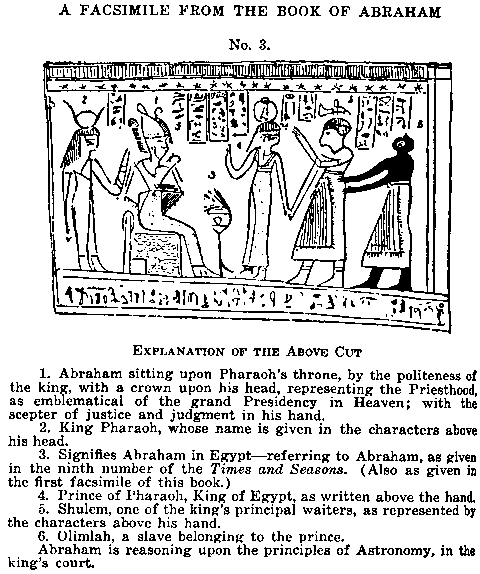
Book of Abraham Facsimile 3


Much criticism has been made about Joseph Smith when it comes to the Book of Abraham. While, I believe, the original egyptian text from which the Book of Abraham was translated is still lost or was destroyed in the Chicago fire of 1871, some of the source material concerning what are called the Facsimiles or three illustrations associated with the Book of Abraham did survive and can be examined.  

One major criticism of Joseph Smith and the Book of Abraham centers on Facsimile 3 which Joseph Smith said depicts Abraham sitting of the throne of Egypt. Pharoah is standing behind Abraham. However Egyptologists can read the text above the heads of each character and immediately see that what is depicted is Hathor, Pharaoh, Maat and Anubis. So, is that it?. Joseph Smith got this wrong proving him a fraud?

Not at all. We need to remember a key detail about Facsimile 3 that many critics overlook. This vignette is not a simple family portrait. Instead, Facsimile 3 is a depiction of a ritual play. So we should not forget that for each figure in the vignette, we will need to understand the actual person who is participating (Abraham. Pharaoh, Prince, Waiter, Servant) in this possible marriage ceremony ritual. and the Egyptian gods that these characters represent (Hathor. Maat, Anubis, etc).

Again, Fascimile 3 is an illustration of a religious ritual. So, we need to keep in mind that what is being depicted is an actor as well as their respective character. 

This is similar to seeing a photograph of a scene from the movie "Star Wars". You could describe the figures in the scene in terms of the charactors: Luke Skywalker, Han Solo, and Pincess Leah or in terms of the actual actors Mark Hamill, Harrison Ford, and Carrie Fisher. 

It shouldn't be a surprise that God through Joseph Smith is more concerned in telling us how Abraham sat upon the throne and taught the Egyptians principles of astronomy more than telling us about Egypt's false gods. 

Wednesday, January 12, 2022

Heartland Model Distances


Knoxsville (Clinch River) to Nauvoo = 613 miles (direct), 645 miles (indirect).
Knoxsville to Nashville = 185 miles.
Nashville to Nauvoo = 460 miles.
Nashville to Cairo, Il (Little Egypt) = 168 miles

Mosiah’s 16 explorers travel from the city of Zarahemla to Lehi-Nephi in 40 days = 15 miles/day = 600 miles. (perfect mileage and pace)

Alma fled 8 days from the Waters of Mormon to the “Land of Helam” and 12 days from Helam to the “Land of Zarahemla”. Traveling from the city of Nephi to the city of Zarahemla could represent over 600 miles / 20 days = 30 miles/day. That would be an unrealistic pace on foot with their flocks and grain.

However, this daily mileage could be increased significantly if Alma’s group were 1. on horseback/wagons 2. travelled downriver on barges, and 3. were “fleeing” the armies of King Noah and not pacing themselves for a months-long migration. 4. generally younger and healthy.

Average Daily Mileage:
LDS handcart pioneer = 15.7 miles/day.
Appalachian Trail Thru-hiker = 2200 miles/5 months = 15 miles/day, (20-25 max daily miles)
Horse-Mounted Company = 30 miles/day

Alma traveling with flocks and grain suggests the refugees were utilized domesticated beasts of burden, carts and wagons. Therefore, it’s not out of the realm of possibility that Alma’s likely energetic group could have pushed near 2.5 mph for 12 hr/day for 8 days = 240 miles max range. Knoxville to Nashville is a very doable 185 miles (23 mil/day, 2.3 mph for 10 hours/day) 

Also, the Book of Mormon may be counting the distance from the Waters of Mormon only to the borders of the “land of Helam” (Mos 23:3), and not the city of Nephi itself to the city of Helam. (ie adjacent river valley). Also, Mormon reports that it was only 12 days from the city of Helam to the “Land of Zarahemla” and does not specify the city of Zarahemla itself (Mos 24:25). Nashville to the border of the Land of Zarahemla (Cairo, Il) would only be a leisurely 168 miles. (1.5 mph x 10 hours/day = 10.5 mil/day x 12 days).  

So, considering the text, we may save on total distance needed to traveled. And, while Alma’s numbers are tight, they are not an order of magnitude off reality. Also, the Limhi detachment running into the Ohio River instead of the Mississippi and mistakenly following the Ohio River up to Upstate New York (Land of Desolation) is a good fit.